ARM controllers will continue to serve as the core computing nodes of smart agriculture, driving the transformation from “experience-based fertilization” to “data-driven, scientific water and fertilizer management.”
Case Details
As modern agriculture rapidly advances toward digitization and intelligence, traditional irrigation and fertilization methods can no longer meet the demands of precision farming. Faced with challenges such as labor shortages, low resource utilization, and unstable crop quality, ARM architecture-based embedded computers are becoming the core computing unit for integrated water and fertilizer management systems. With their high reliability, low power consumption, and flexible scalability, they enable all-weather, precise, and visualized intelligent management in complex environments such as open fields, greenhouses, and orchards.
- Low power consumption and high stability, ideal for unattended environments ARM processors naturally feature low energy use, minimal heat generation, and stable operation, making them perfect for remote agricultural scenarios. When paired with solar power systems, they can operate continuously for extended periods, suitable for distributed irrigation nodes.
- Rich interfaces for seamless connection to sensors and actuators ARM embedded computers typically integrate RS485, CAN, GPIO, ADC, MODBUS, 4G/Wi-Fi, and other interfaces, enabling direct data collection from:
- Soil moisture and temperature
- EC (electrical conductivity), pH
- Weather station data (wind speed, rainfall, evapotranspiration) And direct control of:
- Solenoid valves
- Irrigation pumps
- Dosing pumps (fertilizer injection)
- Proportional valves and fertilizer mixing controllers Achieving a complete closed-loop from sensing to actuation.
- Support for edge intelligent decision-making After installing Node-RED, Python inference modules, or custom algorithms, the ARM controller can locally perform:
- Automated irrigation strategies
- Fertilizer ratio calculation (closed-loop control based on EC and flow)
- Predictive irrigation (using ET models or AI models) Ensuring independent operation even during network instability or offline conditions.
- Cloud connectivity for visualized management Through MQTT, HTTP, or LoRaWAN protocols, it connects to backend platforms and integrates with systems like EMQX, ThingsBoard, Grafana, or Home Assistant to provide:
- Remote monitoring via mobile apps or web dashboards
- Real-time alerts (pressure loss, abnormal flow, low fertilizer level, pump failure)
- Centralized management of multiple sites Allowing farm managers to monitor production status anytime, anywhere.
Typical System Architecture
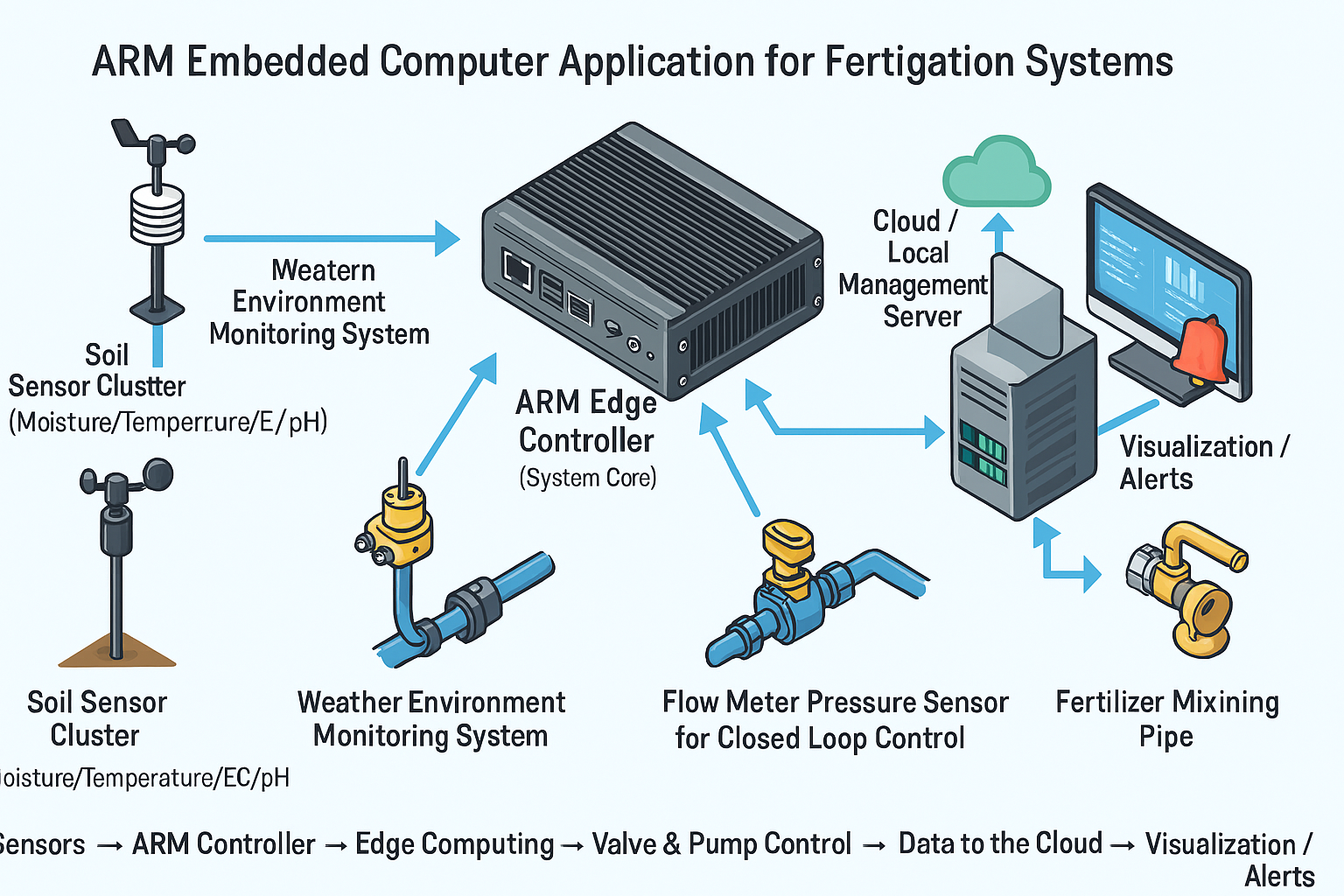
A standard integrated fertilizer + irrigation system usually consists of the following modules:
- ARM edge controller (system core)
- Soil sensor cluster (moisture/temperature/EC/pH)
- Weather and environmental monitoring system
- Water pump and solenoid valve control unit
- Fertilizer dosing pumps and mixing pipelines
- Flow meters and pressure sensors for closed-loop control
- Cloud platform or local management server
Data flow: Sensors → ARM controller → Edge computing → Valve/pump control → Data upload to cloud → Visualization & alerts The controller calculates irrigation duration and fertilizer dosage in real time based on collected moisture, EC, flow, and other data, ensuring crops receive precise water and nutrients.
Operating Mechanism of Intelligent Water-Fertilizer Integration
- Precision irrigation logic
- Set target soil moisture levels for different crop growth stages
- Automatically start irrigation when real-time moisture falls below threshold
- Automatically adjust irrigation duration based on flow meter feedback
- Skip irrigation cycles when rainfall is detected or evapotranspiration is low
- Automated fertilizer control The system dynamically controls dosing pumps using EC, conductivity, and flow data to achieve precise nutrient solution ratios:
- Automatically calculate fertilizer injection percentage based on target EC
- Real-time adjustment of fertilizer amount according to water volume, achieving milliliter-level precision
- Trigger alarms and stop fertilization if EC fluctuates abnormally or solution is insufficient
- Safety interlock and protection mechanisms The ARM controller continuously monitors system health:
- Low pressure → stop irrigation and send alert
- Abnormal flow (blockage/leak) → automatically close valves
- Pump overload or dry running → automatic power cutoff protection Ensuring long-term stable and safe operation.
Typical Application Scenarios
- Open-field agriculture (corn, wheat, vegetable bases) Zone-based valve control enables automated irrigation scheduling across multiple areas.
- Smart greenhouses (strawberry, tomato cultivation) Precise control of nutrient solution EC and pH for high-quality crop production.
- Orchards and fruit plantations (grapes, blueberries, citrus) Precise irrigation cycles based on seasonal evapotranspiration and real-time soil data.
- Distributed irrigation systems (hilly areas, pipeline networks) Controllers communicate with central platforms via 4G/LoRaWAN, ideal for large-scale distributed deployments.
Summary of System Benefits
- Water savings of 20%–40%: on-demand supply avoids over-irrigation
- Fertilizer efficiency improvement of 20%–30%: precise formulation reduces waste
- Increased yield and quality: more stable water and nutrient status
- Significant labor cost reduction: automated operation and remote management
- Enhanced reliability: industrial-grade ARM controllers withstand harsh outdoor conditions
Future Development Trends
With the growing adoption of AI and IoT in agriculture, ARM embedded computers will enable more advanced functions in water-fertilizer integration systems:
- AI-based crop growth models for predicting irrigation needs
- Vision-based diagnosis of pests, diseases, and nutrient deficiencies
- Multi-site collaborative scheduling to optimize water resource efficiency
- Deeper integration with comprehensive digital farm management platforms
ARM controllers will continue to serve as the core computing nodes of smart agriculture, driving the transformation from “experience-based fertilization” to “data-driven, scientific water and fertilizer management.”


