ARM programmable controllers improve textile quality through real-time monitoring and intelligent control, significantly reducing production risks and costs in textile machinery.
Case Details
In the textile industry, the stability of yarn tension and loom speed is critical to fabric quality. Excessive yarn tension can cause yarn breakage, while insufficient tension may lead to loose fabric or wrinkles. Similarly, asynchronous loom speed with the traction or winding system can result in fabric streaks or uneven weft density. Traditional mechanical tension control methods struggle to meet modern demands for high efficiency and quality.
With the rise of smart manufacturing and the Industrial Internet of Things (IIoT), ARM-based programmable controllers have become a key component in upgrading textile machinery due to their low power consumption, high real-time performance, and versatile interfaces. By enabling real-time monitoring and closed-loop control of yarn tension and loom speed, ARM controllers significantly reduce yarn breakage rates, improve fabric quality, and deliver substantial economic benefits to factories.
System Architecture
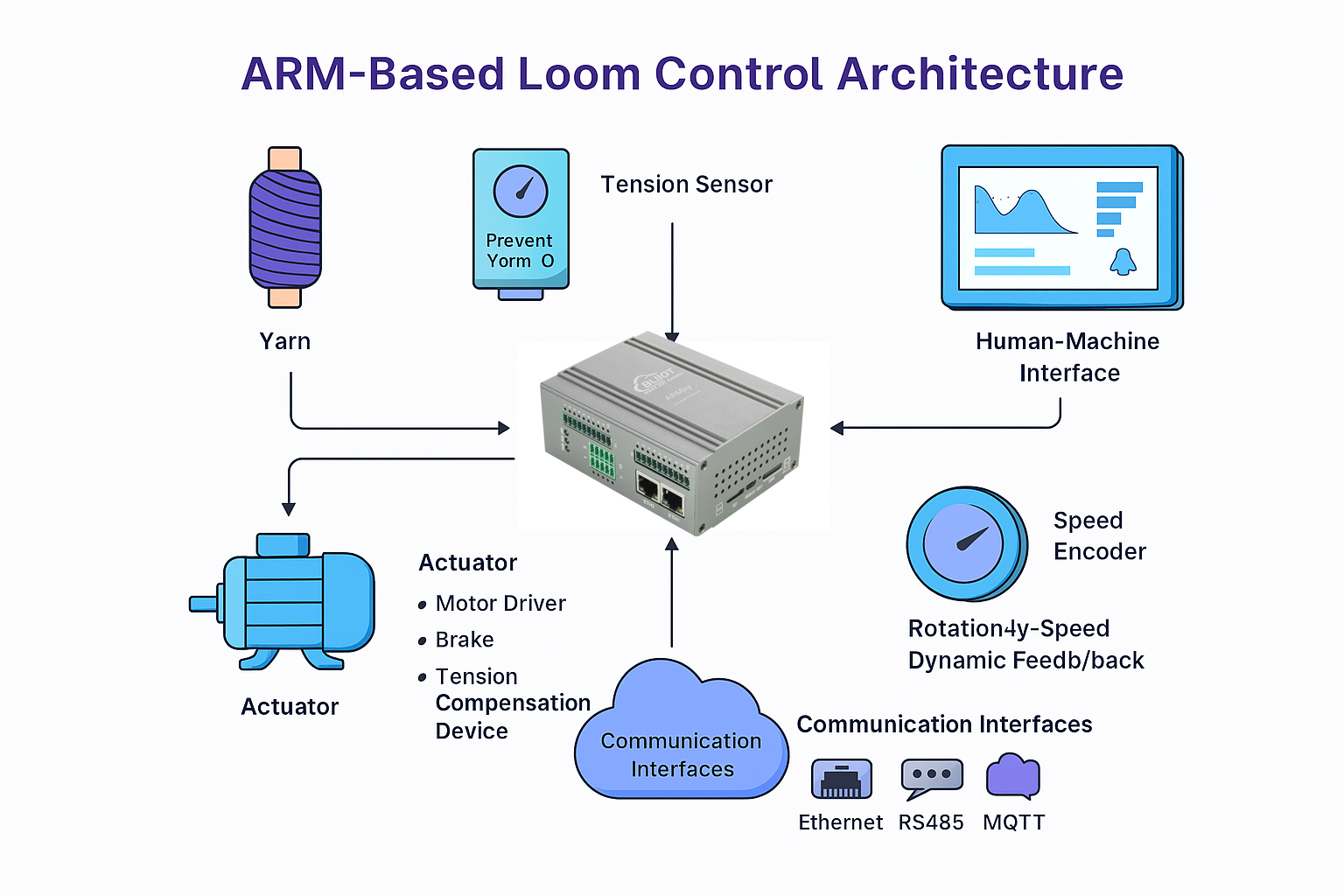
The ARM programmable controller BL350 serves as the core control unit, integrating the following components:
- Tension Sensors: Real-time monitoring of yarn tension, with signals collected via analog input interfaces.
- Speed Encoders: Measure the rotational speed of the loom’s main shaft and traction rollers, providing high-frequency pulse feedback.
- Actuators: Include motor drivers, brakes, and tension compensation devices for dynamic adjustments.
- Human-Machine Interface (HMI): Displays tension curves, loom speed, and alarm information, enabling operators to adjust process parameters.
- Communication Interfaces: Support Ethernet, RS485, or MQTT protocols for integration with SCADA and MES systems, facilitating remote monitoring and data sharing.
This architecture enables local real-time closed-loop control while supporting remote maintenance and data analysis.
Core Functions
- Tension Closed-Loop Control: The ARM controller runs a PID algorithm to process real-time data from tension sensors, dynamically adjusting motor output or brake actions to maintain yarn tension within the required range.
- Speed Synchronization and Compensation: By comparing the speeds of the loom’s main shaft and winding mechanism, the controller ensures synchronization, eliminating fabric defects caused by speed imbalances.
- Yarn Breakage Detection and Rapid Response: Upon detecting sudden tension changes or abnormal speed feedback, the controller triggers an alarm and initiates an emergency stop to minimize fabric loss.
- Data Logging and Traceability: Supports local storage and cloud uploads, recording tension waveforms, speed curves, and alarm logs for quality traceability and process optimization.
- Remote Maintenance: Via MQTT or 4G modules, the controller enables remote parameter adjustments and firmware upgrades, reducing maintenance costs.
Case Study
On a weft knitting machine production line in a large textile factory, the adoption of ARM programmable controllers resulted in:
- A 35% reduction in yarn breakage rate;
- A 40% decrease in fabric defects;
- Over 95% uptime for the production line;
- Real-time generation of production data reports, meeting batch quality traceability requirements.
Application Value
- Improved Product Quality: Stable yarn tension and loom speed reduce fabric imperfections.
- Reduced Production Losses: Lower yarn breakage and rework rates save raw materials and time.
- Enhanced Flexible Manufacturing: Supports rapid switching between different yarn types and fabric processes.
- Support for Smart Factories: Integration with MES/ERP systems enables intelligent production management.
Conclusion
The application of ARM programmable controllers in textile machinery exemplifies the deep integration of industrial control and smart manufacturing. Through real-time monitoring and intelligent control, these controllers enhance textile quality while significantly reducing production risks and costs. In the future, with further advancements in IIoT and AI technologies, ARM controllers will play an even greater role in the textile industry, driving higher levels of automation and intelligence.


