ARM Linux industrial computers improve food processing efficiency and quality through real-time monitoring and intelligent control, becoming a key driver for promoting intelligent food manufacturing.
Case Details
Food processing lines demand stringent control over environmental conditions and process parameters, such as temperature, mixing speed, and conveyor timing, which directly impact product quality and safety. Achieving efficient, stable, and traceable production control is a critical challenge for food enterprises. ARM Linux industrial computers, with their low power consumption, real-time performance, versatile interfaces, and open operating system, are emerging as an ideal solution for food processing automation.
Application Background
Traditional food processing lines often rely on PLCs or PCs for single-point control, facing limitations in monitoring scope, scalability, and cloud integration. With the rise of the Industrial Internet and smart manufacturing, food enterprises seek intelligent devices for edge computing, real-time monitoring, and cloud connectivity to enhance product consistency and meet food safety regulations.
System Architecture and Working Principle
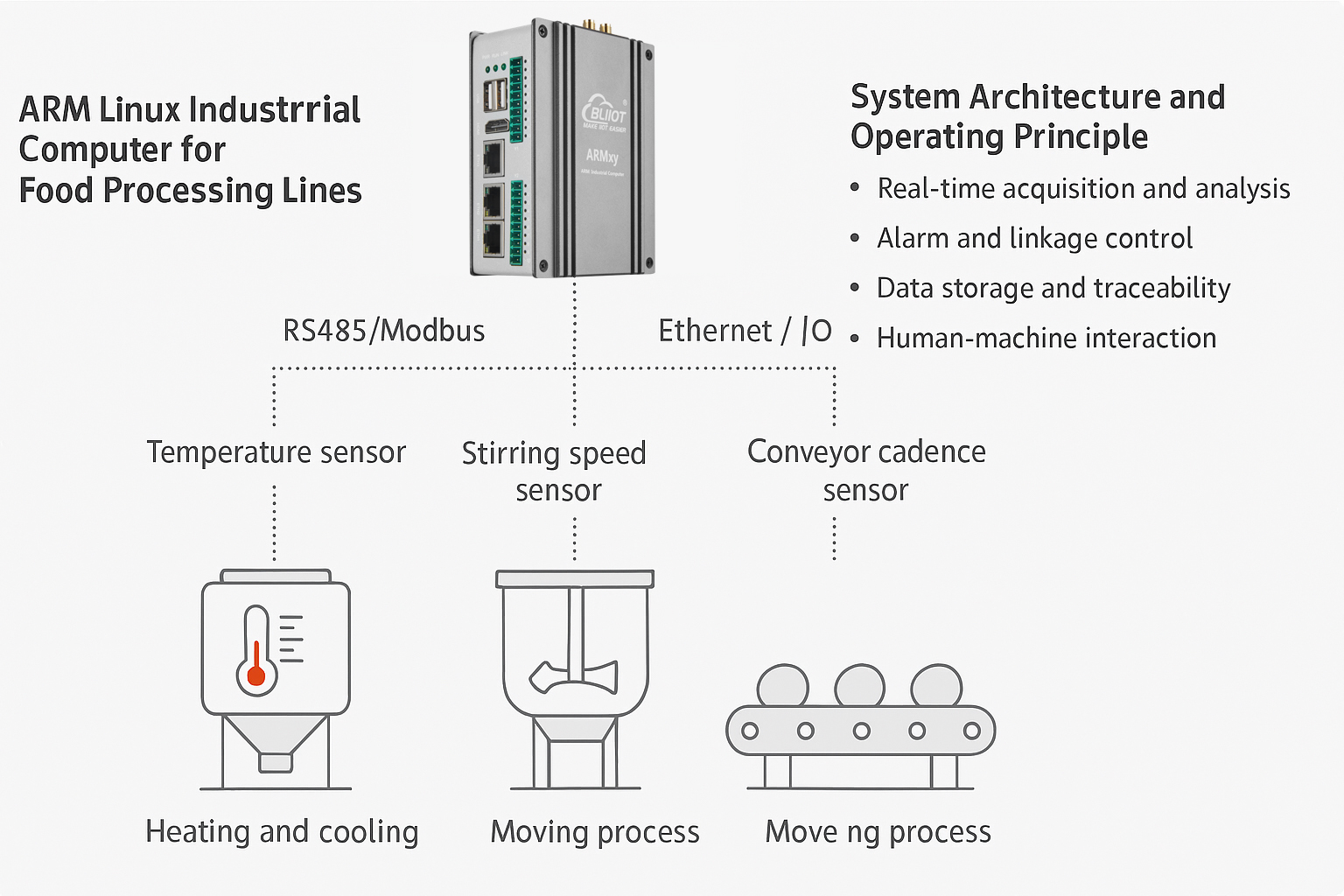
In a typical food processing line, the ARM Linux industrial computer BL360 Series serves as the core edge control unit, interfacing with various sensors and actuators:
- Temperature Sensors: Monitor heating and cooling processes to ensure food is processed within safe temperature ranges.
- Mixing Speed Sensors: Track motor speed in real-time to ensure uniform mixing and minimize quality variations.
- Conveyor Timing Sensors: Monitor conveyor operations to prevent material accumulation or shortages.
Connected via RS485/Modbus, Ethernet, and IO interfaces, the ARM Linux industrial computer runs local monitoring software to perform the following functions:
- Real-Time Data Acquisition and Analysis: Collects sensor data at high frequency, performing filtering, anomaly detection, and statistical analysis.
- Alarm and Interlinked Control: Triggers audio-visual alarms when temperature, speed, or timing exceeds thresholds, issuing stop or adjustment commands as needed.
- Data Storage and Traceability: Stores historical data locally and periodically uploads it to MES/SCADA systems or cloud platforms to comply with food safety regulations.
- Human-Machine Interaction: Displays real-time curves and historical records via touchscreens or web interfaces, enabling operators to monitor process status.
Key Advantages
- High Reliability: Industrial-grade design, suited for high-humidity, dusty, and temperature-fluctuating food processing environments.
- Openness and Flexibility: Linux-based system supports secondary development, multi-protocol communication, and algorithm deployment.
- Energy Efficiency: Low-power ARM processors ensure 24/7 operation with minimal energy consumption.
- Intelligence: Supports edge computing, running rule engines or AI models for early anomaly detection.
- Compliance and Traceability: Provides a complete data chain for batch management and food safety audits.
Application Outcomes
By deploying ARM Linux industrial computers, food processing enterprises can:
- Control temperature fluctuations within ±2°C, significantly reducing defect rates;
- Achieve stable mixing processes, minimizing quality variations;
- Ensure efficient conveyor operations with precise production timing;
- Establish a robust digital record system.
Conclusion
ARM Linux industrial computers enhance food processing efficiency and quality through real-time monitoring and intelligent control. They provide strong support for the digital transformation of traditional production lines, serving as a vital tool for advancing smart manufacturing and food safety compliance.


