ARM IoT Gateway demonstrates exceptional value in river and lake water quality monitoring. Its low power consumption and high reliability ensure stable long-term operation, while edge computing enhances data processing efficiency and response speed.
Case Details
In modern water environment management, real-time water quality monitoring is critical for ensuring ecological safety and public health. ARM IoT Gateway, with their low power consumption, high reliability, and edge computing capabilities, are ideal for deployment in rivers and lakes to build intelligent water quality monitoring systems.
Application Scenarios
- River Section Monitoring: Deployed at key river sections to continuously track water quality changes.
- Lake Water Monitoring: Utilizes multiple buoy nodes to form a monitoring network covering large water areas.
- Water Source Protection: Real-time monitoring of drinking water sources with early warnings for pollution events.
System Architecture and Functions
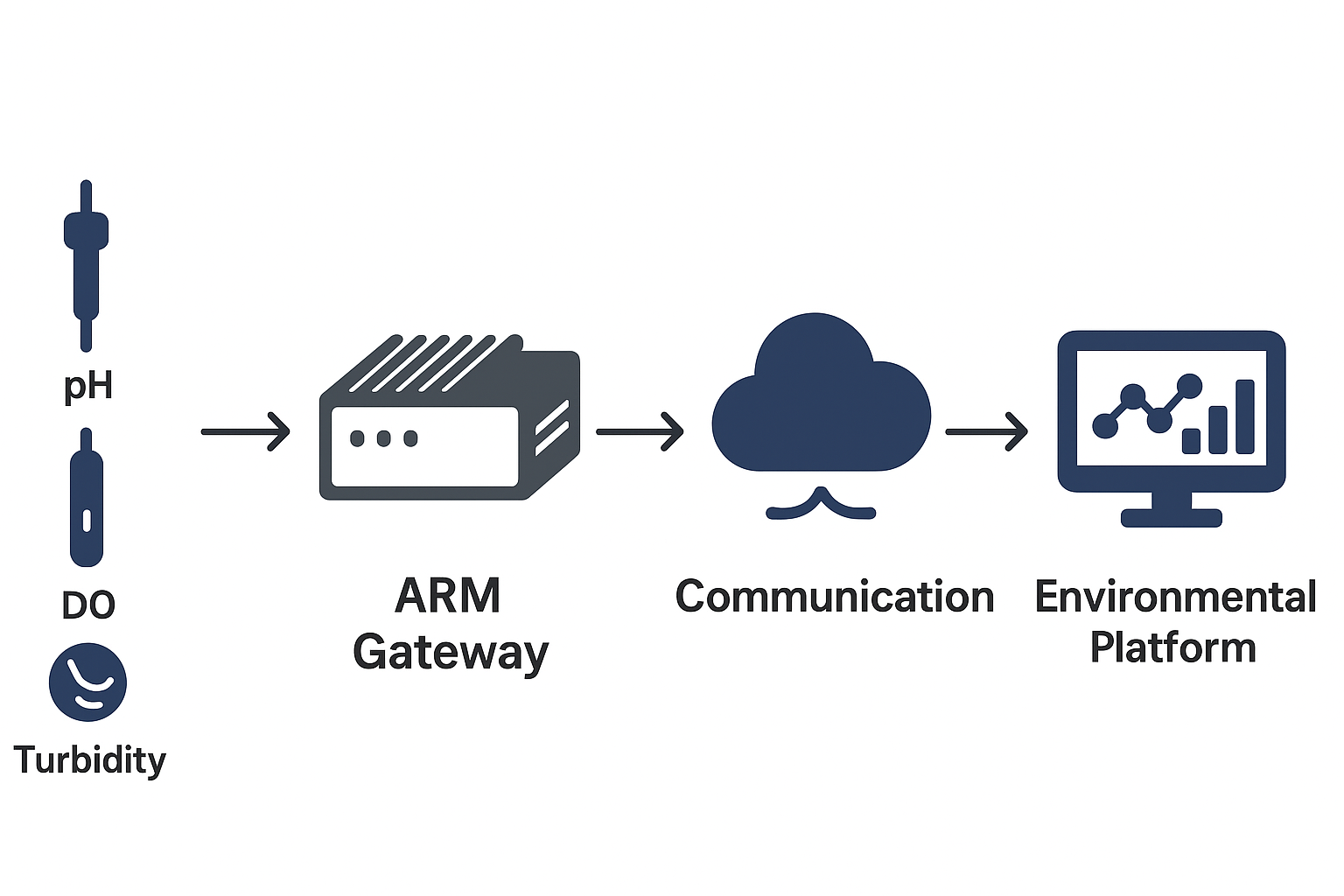
- Data Collection:
- Employs sensors for pH, dissolved oxygen, and optical turbidity, collecting data via RS485/analog interfaces.
- Supports multi-point expansion for wide-area monitoring needs.
- Edge Processing:
- ARM IoT Gateway BL335 series performs data filtering, anomaly detection, and local storage.
- Enables offline data continuity and on-site alerts (e.g., pH threshold alarms).
- Data Transmission:
- Supports 4G/5G, Ethernet, and WiFi communication methods.
- Securely uploads encrypted data to environmental monitoring platforms, integrating with cloud-based AI for trend analysis and predictions.
- Environmental Platform Integration:
- Aggregates data from multiple sites, generating water quality trend curves and spatial distribution maps.
- Automatically produces regulatory reports to support environmental decision-making.
Advantages
- Low Power Consumption: Supports solar power, ideal for long-term field operations.
- High Reliability: Industrial-grade design, suitable for harsh outdoor conditions like high temperature and humidity.
- Edge Intelligence: Local processing reduces cloud dependency and enhances response speed.
- Flexible Compatibility: Open interfaces facilitate integration with various sensors and platforms.
Conclusion
The ARM IoT Gateway demonstrates exceptional value in river and lake water quality monitoring. Its low power consumption and high reliability ensure stable long-term operation, while edge computing enhances data processing efficiency and response speed. The open interface design provides excellent scalability and compatibility. By seamlessly integrating with environmental platforms, this system not only enables real-time water quality monitoring but also provides data-driven decision support for water environment management, making it a key technical solution for advancing smart environmental protection.


