ARM Edge Controllers are a powerful tool for modernizing wastewater treatment plants. They improve efficiency, reduce costs, and enhance the overall reliability of the treatment process.
Case Details
In modern wastewater treatment plants, achieving energy-efficient operations and consistent compliance with discharge standards is a shared goal of operators and regulators. With the rapid development of smart manufacturing and the Industrial Internet, ARM edge controllers have emerged as a key enabler for the intelligent upgrading of wastewater treatment facilities. They facilitate real-time data collection, local control, and edge computing to optimize operational strategies, significantly reducing energy consumption and enhancing water quality stability.
Background and Needs
Wastewater treatment involves complex processes such as biochemical treatment, chemical dosing, and sludge recirculation. Traditional PLC or manual control methods often face the following challenges:
- High Energy Consumption: Blowers typically operate at fixed frequencies, accounting for over 50% of the plant’s total energy use.
- Imprecise Dosing: Dosing pumps often rely on manual or fixed-rate control, leading to overuse or underuse of chemicals.
- Limited Monitoring: Manual inspections or lab testing cannot provide real-time insights into water quality fluctuations.
- Lack of Intelligent Optimization: Traditional controls struggle to adapt predictively to load changes, resulting in unstable processes.
Functions of ARM Edge Controllers
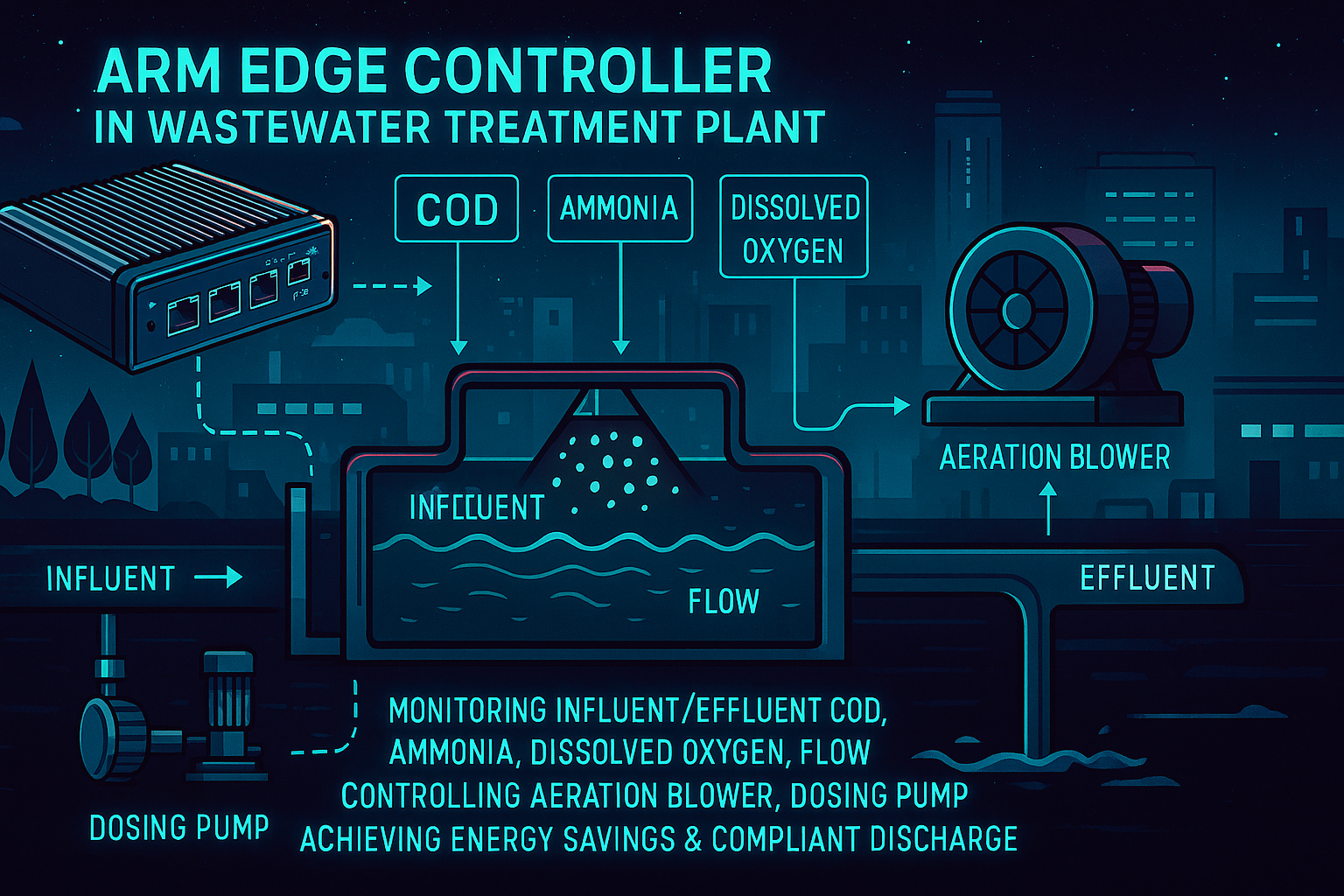
As the core of local intelligent control, ARM edge controllers offer the following capabilities:
- Real-Time Monitoring
- Collects key parameters such as COD, ammonia nitrogen, dissolved oxygen (DO), and flow rate.
- Integrates auxiliary signals like liquid level, pH, temperature, and turbidity.
- Supports multiple industrial interfaces, including 4-20mA, 0-10V, RS485/Modbus, and Ethernet.
- Local Control
- Adjusts blower frequency in real time based on DO feedback for precise oxygen supply.
- Optimizes dosing pump rates based on influent load and effluent quality to improve chemical efficiency.
- Coordinates sludge pumps, valves, and other equipment for seamless process control.
- Edge Optimization
- Uses data filtering, anomaly detection, and predictive models to anticipate water quality changes.
- Dynamically adjusts aeration and dosing strategies to minimize energy and chemical waste.
- Runs optimization algorithms locally to enhance real-time performance and reduce cloud dependency.
- Data Integration and Visualization
- Uploads data to SCADA or cloud platforms via MQTT, OPC UA, or Modbus TCP protocols.
- Supports breakpoint resumption and local caching to ensure data integrity.
- Provides HMI or web interfaces for on-site operation and remote monitoring.
- Alarms and Maintenance
- Implements multi-level alarms for sensor failures, non-compliant discharges, or equipment issues.
- Offers remote diagnostics and maintenance interfaces to reduce manual inspections.
- Supports historical data analysis and report generation for operational insights.
Application Benefits
- Energy and Cost Savings
- Intelligent aeration reduces blower energy consumption by 20%–40%.
- Precise dosing cuts chemical waste by 10%–20%.
- Improved Effluent Stability
- Real-time monitoring and closed-loop control prevent COD and ammonia nitrogen exceedances.
- Predictive adjustments enhance system resilience to load variations.
- Intelligent Operations
- Edge computing ensures process stability during network disruptions.
- Alarms and predictive maintenance improve equipment reliability and lifespan.
- Compliance and Sustainability
- Ensures consistent effluent quality to meet regulatory standards.
- Provides comprehensive operational and discharge data for audits and oversight.
Conclusion
With their low power consumption, high performance, and flexible scalability, ARM edge controllers are central to the digital and intelligent transformation of wastewater treatment plants. They address challenges such as high energy use, inadequate monitoring, and delayed control, while significantly improving efficiency and management through intelligent optimization and remote operations. As demands for energy conservation and smart operations grow, ARM-based edge control solutions will see increasingly widespread adoption in the wastewater treatment industry.


