ARM controllers in oilfield wellhead pressure and temperature monitoring meets the oilfield's need for remote, real-time, and reliable data collection, providing solid technical support for safe and intelligent oilfield operations.
Case Details
In the daily operations of oil and gas fields, wellhead pressure and temperature are among the most critical parameters. These metrics not only reflect the production capacity of the well but also directly impact the safety and stability of the production process. As oilfields advance toward digitalization and intelligence, traditional manual inspections and single-point instruments struggle to meet the demands for real-time, accurate, and remote monitoring. Low-power, highly reliable ARM controllers have emerged as an ideal solution for wellhead data acquisition and control.
System Components
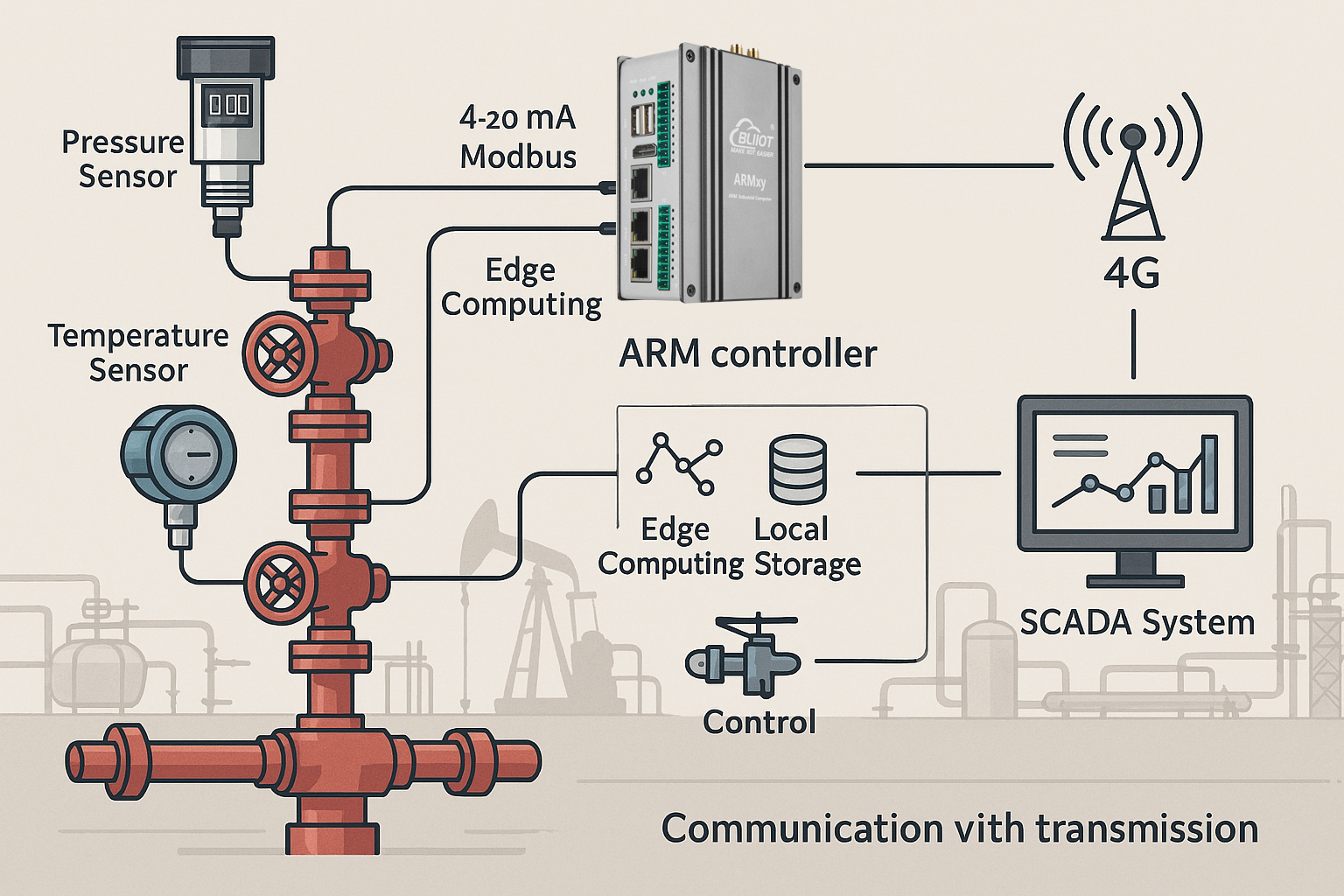
Sensor Layer
-
Wellhead Pressure Sensors: Monitor casing pressure, tubing pressure, and annulus pressure.
-
Temperature Sensors: Measure real-time temperature changes at the wellhead and in fluids to prevent abnormal fluctuations.
-
Multi-Channel Acquisition: Interfaces with multiple sensors via 4–20mA, RS485, Modbus, and other industrial protocols.
-
Edge Computing: Performs on-site filtering, data cleansing, anomaly detection, and trend analysis.
-
Interlinked Control: Automatically activates solenoid valves, safety valves, or alarm systems when pressure or temperature exceeds limits, preventing blowouts and leaks.
-
Local Storage: Records data during communication interruptions to ensure complete production logs.
Communication and Transmission Layer
Monitoring and Management Layer
-
Real-Time Monitoring: The control center can view wellhead pressure, temperature curves, and alarm statuses in real time.
-
Data Analysis: Supports historical data analysis to aid in formulating production optimization strategies.
Application Benefits
-
Enhanced Safety: Real-time monitoring and automated responses reduce risks such as blowouts and equipment damage.
-
Improved Operational Efficiency: Remote data acquisition reduces the need for manual inspections, lowering labor and time costs.
-
Production Optimization: Long-term monitoring data supports reservoir analysis, production capacity evaluation, and enhanced recovery measures.
-
Adaptability to Harsh Environments: Low-power ARM controllers, combined with solar or battery power, enable unmanned wellsite operations.
Conclusion
The application of ARM controllers in oilfield wellhead pressure and temperature monitoring addresses the need for remote, real-time, and reliable data acquisition. It provides robust technical support for safe and intelligent oilfield operations. Looking ahead, the integration of 5G and AI technologies will further enhance the role of ARM controllers, driving the industry toward greater efficiency, safety, and intelligence.


