Injection molding machines play a pivotal role in manufacturing plastic components for diverse industries, including automotive parts, home appliances, consumer electronics, and medical devices. Conventional control systems, typically based on Programmable Logic Controllers (PLCs) or proprietary hardware, often struggle with limitations in energy efficiency, precision control, and seamless integration with contemporary manufacturing ecosystems.
In the era of smart manufacturing and Industrial Internet of Things (IIoT), integrating an ARM-based edge controller into injection molding machines addresses these challenges. This solution enables real-time monitoring, intelligent automation, and robust connectivity to cloud platforms, paving the way for enhanced operational excellence.
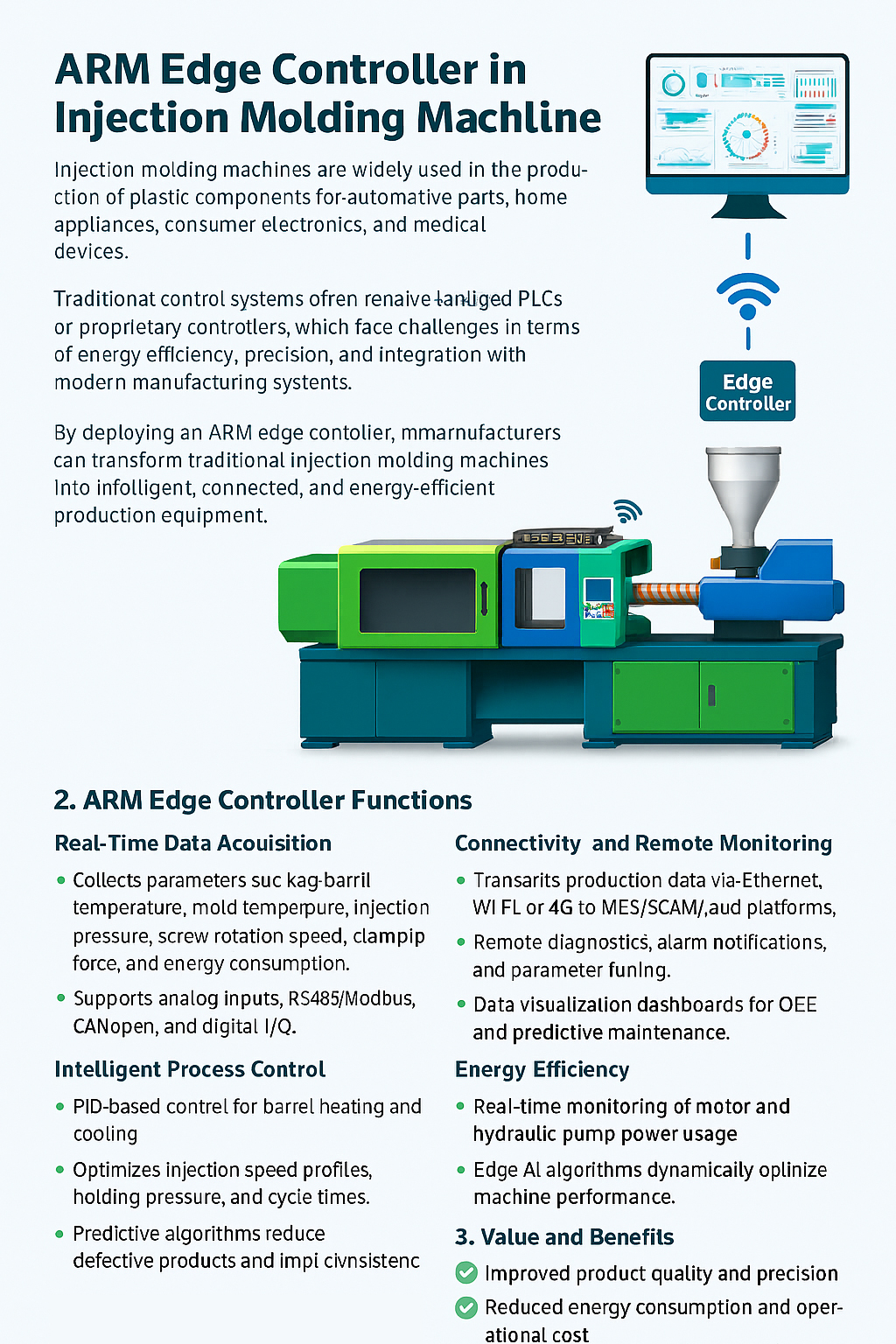
The ARM edge controller serves as a versatile, high-performance hub that elevates machine capabilities through advanced data handling and automation. Below are its core functions:
Real-Time Data Acquisition
- Captures critical operational parameters, including barrel temperature, mold temperature, injection pressure, screw rotation speed, clamping force, and energy consumption.
- Interfaces with diverse hardware via analog inputs, RS485/Modbus protocols, CANopen, and digital I/O for comprehensive sensor integration.
Intelligent Process Control
- Employs PID (Proportional-Integral-Derivative) algorithms for precise barrel heating and cooling management.
- Dynamically optimizes injection speed profiles, holding pressure, and cycle times to ensure consistent output.
- Leverages predictive algorithms to minimize defects, enhance product uniformity, and adapt to varying production demands.
Connectivity and Remote Monitoring
- Facilitates seamless data transmission over Ethernet, Wi-Fi, or 4G networks to Manufacturing Execution Systems (MES), Supervisory Control and Data Acquisition (SCADA), or cloud platforms.
- Supports remote diagnostics, instant alarm notifications, and on-the-fly parameter adjustments.
- Provides intuitive data visualization dashboards to track Overall Equipment Effectiveness (OEE) and enable predictive maintenance scheduling.
Energy Efficiency
- Monitors motor and hydraulic pump power usage in real time for proactive optimization.
- Utilizes edge AI algorithms to fine-tune machine performance dynamically, reducing waste and improving sustainability.
- Integrates effortlessly with servo drives and Variable Frequency Drives (VFDs) to achieve significant energy savings without compromising productivity.
Value and Benefits
 The adoption of an ARM edge controller delivers tangible advantages, transforming legacy equipment into a cornerstone of Industry 4.0:
- ✅ Improved Product Quality and Precision: Enhanced control algorithms ensure tighter tolerances and fewer rejects, leading to superior end-products.
- ✅ Reduced Energy Consumption and Operational Costs: Intelligent optimization cuts power usage by up to 20-30% (depending on application), lowering utility bills and environmental impact.
- ✅ Smart Factory Integration and Digital Transformation: Enables IIoT connectivity for end-to-end visibility, fostering agile and data-driven decision-making.
- ✅ Extended Equipment Lifecycle with Predictive Maintenance: Early detection of anomalies prevents breakdowns, extending machine uptime and reducing downtime-related losses.
Summary
In summary, the ARM-based edge controller revolutionizes injection molding by bridging the gap between traditional machinery and modern smart manufacturing paradigms. By enabling real-time data acquisition, intelligent control, robust connectivity, and energy-efficient operations, it not only boosts productivity and product quality but also drives cost savings and sustainability. Manufacturers embracing this technology can achieve a competitive edge through digital transformation, ultimately turning conventional injection molding machines into agile, connected assets that support long-term innovation and efficiency in high-volume production environments.


 The adoption of an ARM edge controller delivers tangible advantages, transforming legacy equipment into a cornerstone of Industry 4.0:


