The synergy between ARM AI edge controllers and OpenCV not only offers a cost-effective solution for industrial vision recognition but also accelerates the adoption of edge intelligence in manufacturing.
Case Details
As industrial automation and intelligent manufacturing continue to converge, edge computing and visual recognition technologies are becoming key drivers of productivity and quality improvement. This article explores how ARM-based AI edge controllers, combined with the OpenCV vision library, can deliver efficient, stable, and scalable smart vision solutions—empowering industrial sites to “see clearly, judge accurately, and respond swiftly.”
Technical Architecture Overview

ARM AI edge controllers offer high performance, low power consumption, and rich I/O interfaces, making them ideal for on-site intelligent inference. When paired with OpenCV, an open-source computer vision library, they enable a complete closed-loop system—from image acquisition and processing to object recognition and control decisions.
Core components include:
-
ARM Edge Controller: Multi-core processor, NPU acceleration, industrial-grade I/O.
-
OpenCV Vision Library: Image processing, feature extraction, object recognition.
-
AI Models (e.g., YOLO, MobileNet): Real-time object detection and classification.
-
Control Logic Module: Drives actuators via PLC or GPIO interfaces.
Performance Optimization Strategies
To run OpenCV and AI models efficiently on ARM platforms, multi-layered optimization is essential:
OpenCV Build Optimization
-
Enable NEON and VFP acceleration for faster image processing.
-
Use OpenMP for parallel computation across multiple cores.
-
Streamline modules by removing GUI and unused components to reduce footprint.
Model Lightweighting and Inference Acceleration
-
Deploy lightweight models in TensorFlow Lite or ONNX format.
-
Leverage ARM NPUs for hardware-accelerated inference.
-
Use asynchronous image capture and inference pipelines for millisecond-level response.
Typical Application Scenarios
| Scenario |
Functional Combination |
Value Delivered |
| Defect Detection |
OpenCV + YOLO + GPIO Control |
Higher yield, reduced labor cost |
| Automated Sorting |
Multi-object recognition + control + robotics |
Smart logistics, precise handling |
| Security Monitoring |
Face recognition + video stream analysis |
Real-time alerts, site safety |
| Workpiece Measurement |
Dual cameras + OpenCV geometric analysis |
High precision, low complexity |
Deployment & Expansion Recommendations
-
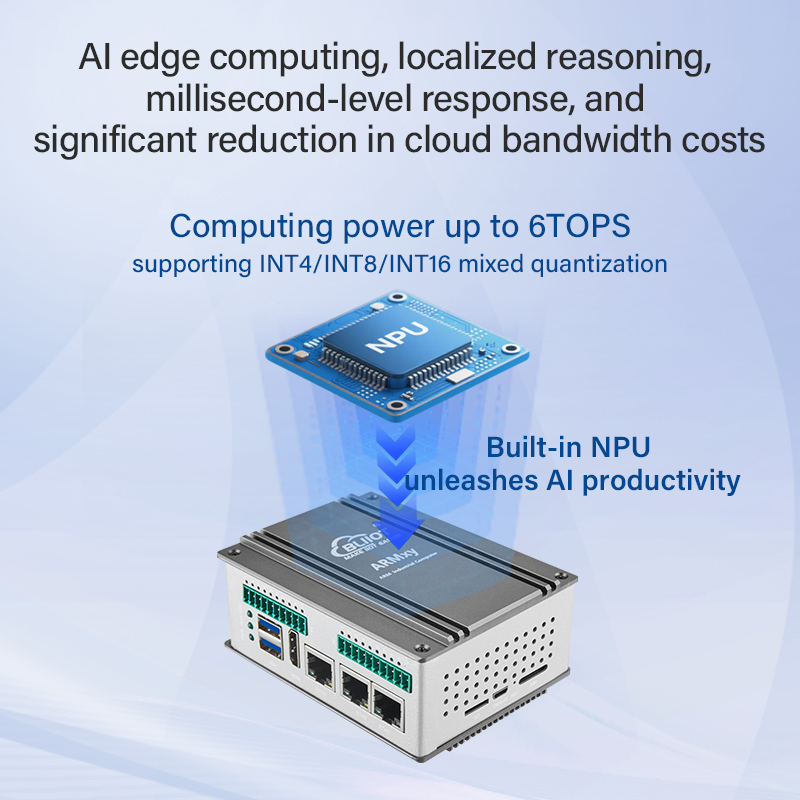
Choose ARM platforms with NPU support (e.g., RK3562 BL370 series, RK3588 BL450 Series) for better AI performance.
-
Pair with industrial cameras and lighting control modules to ensure stable image quality.
-
Use Docker containers for version control and remote maintenance.
-
Connect to industrial gateways for data integration with MES and SCADA systems.
Conclusion
The synergy between ARM AI edge controllers and OpenCV not only offers a cost-effective solution for industrial vision recognition but also accelerates the adoption of edge intelligence in manufacturing. As algorithms and hardware continue to evolve, this solution will unlock greater potential across diverse scenarios—becoming a core driver of smart factories.


