The combination of Home Assistant and an ARM controller transcends a simple smart home solution, becoming a fully functional edge intelligence platform.
Case Details
Home Assistant is a globally renowned open-source platform for managing smart homes, focused on delivering a "localized, customizable, and secure" automation control system. It integrates thousands of brands and protocols for smart devices—including lights, air conditioners, cameras, sensors, access controls, and voice assistants—enabling unified visualization, management, and automated logic orchestration.
Key features of Home Assistant include:
- 🧩 Openness: Supports over 2,000 devices and protocols (e.g., MQTT, Modbus, Zigbee, Z-Wave, Wi-Fi, RS485);
- 🔒 Data Privacy and Security: All data is stored locally on your server by default, with no cloud uploads required;
- ⚙️ High Customizability: Complex automation logic can be built using YAML, Python, or Node-RED;
- 🌐 Multi-Platform Accessibility: Compatible with web browsers, mobile apps, and voice assistants (e.g., Google Home, Alexa).
In essence, Home Assistant acts as a "central hub," allowing users to manage all smart devices in their home or facility through a unified "digital brain."
Why Choose an ARM Controller for Running Home Assistant?
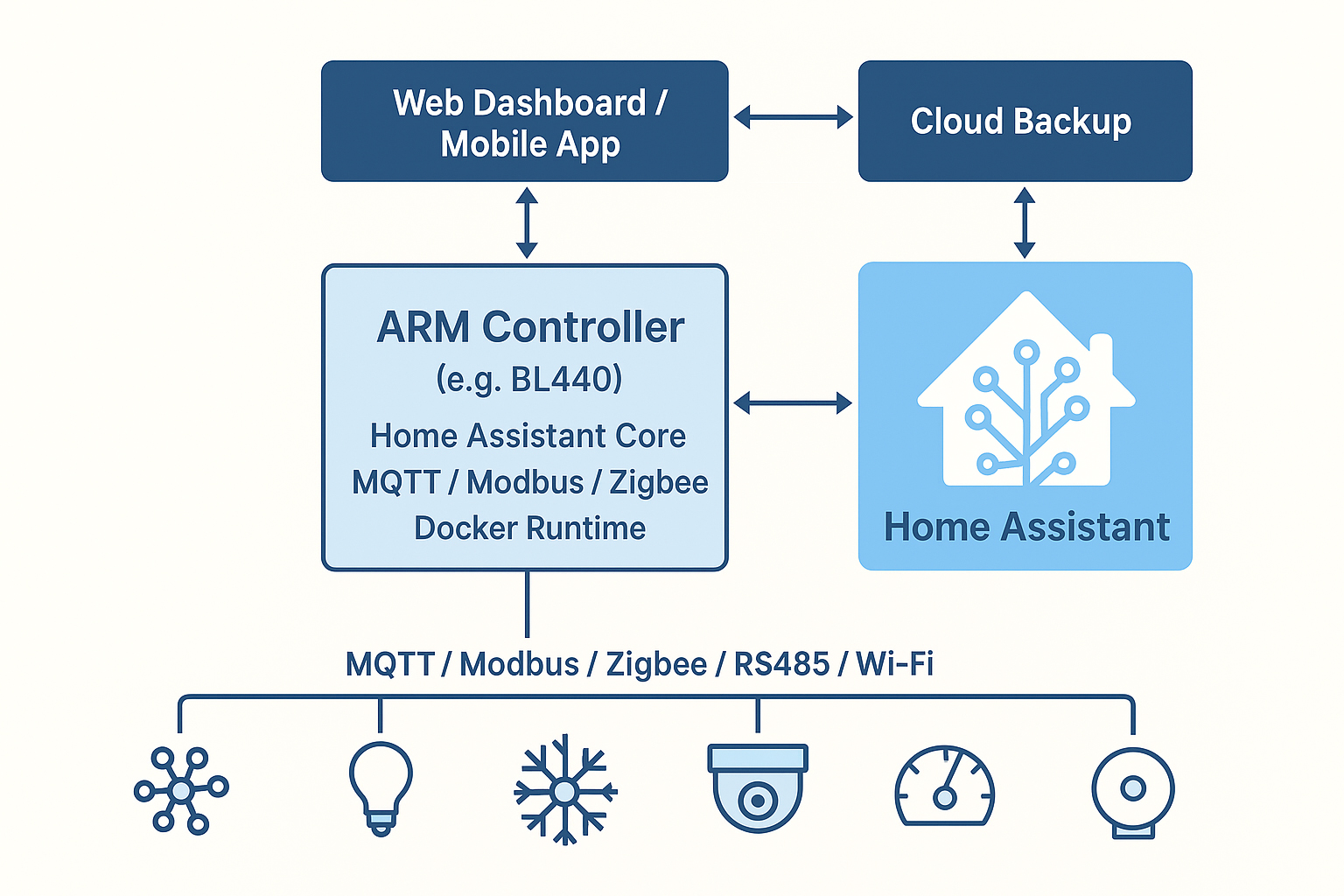
Selecting the right hardware is crucial when deploying Home Assistant. Compared to traditional x86 servers or Raspberry Pi boards, ARM-based industrial controllers (such as Barium ReTech's BL series) offer superior stability, interface compatibility, power efficiency, and local processing capabilities.
For instance, models like the BL440 (powered by RK3576) or BL450 (powered by RK3588) provide:
- Powerful Processing: Multi-core ARM Cortex CPUs, with some models featuring NPUs delivering up to 26 TOPS of AI compute power;
- Rich Industrial Interfaces: RS485, RS232, DI/DO, CAN, Ethernet, Wi-Fi, 4G modules, and more;
- Low-Power, Reliable Operation: Enables 7x24-hour continuous runtime, ideal for edge deployments;
- System Flexibility: Compatible with Debian, Ubuntu, Buildroot, Yocto, and easy Docker installation;
- Edge Computing Capabilities: Supports on-device data analysis, AI recognition, and automated decision-making, reducing cloud dependency.
These attributes make ARM controllers an ideal hardware foundation for Home Assistant.
Benefits of Integration
- Localized Smart Control No cloud dependency—all logic and data reside within the ARM controller for fast, secure, and reliable responses.
- Strong Edge Computing Run AI models or data analytics directly on the controller to enable features like device recognition, energy forecasting, and environmental adjustments.
- Multi-Protocol Fusion Seamlessly integrates industrial and home protocols (e.g., Modbus RTU, MQTT, Zigbee, RS485), allowing interoperability across diverse brands.
- Stability and Energy Efficiency Low power consumption, minimal heat generation, and fanless design support 24/7 operation, perfect for smart buildings or remote sites.
- High Scalability Docker-based deployment allows co-running tools like Node-RED, Grafana, and InfluxDB on the same device for advanced data analytics and visualization.
Typical Application Scenarios
- Smart Home Systems: Centralized control of lighting, HVAC, security cameras, and access systems;
- Smart Buildings and Hotels: Automated energy optimization and guest room monitoring;
- Industrial Environmental Monitoring: RS485-based sensor data collection and visualization in Home Assistant;
- Smart Agriculture: Integration with temperature/humidity sensors, fans, and pumps for automated irrigation and climate control;
- AI Security (RK3588 Platform): Combine OpenCV with Home Assistant for automated alerts and threat detection.
Conclusion
The combination of Home Assistant and ARM controllers goes beyond a simple smart home solution—it's a versatile edge intelligence platform. It addresses automation needs across residential, commercial, and industrial settings with lower power use, higher reliability, and enhanced customizability, making true smart control a reality.
Looking ahead, as ARM platforms advance in compute power and ecosystem maturity, this integration will emerge as a cornerstone architecture in the smart automation landscape.


