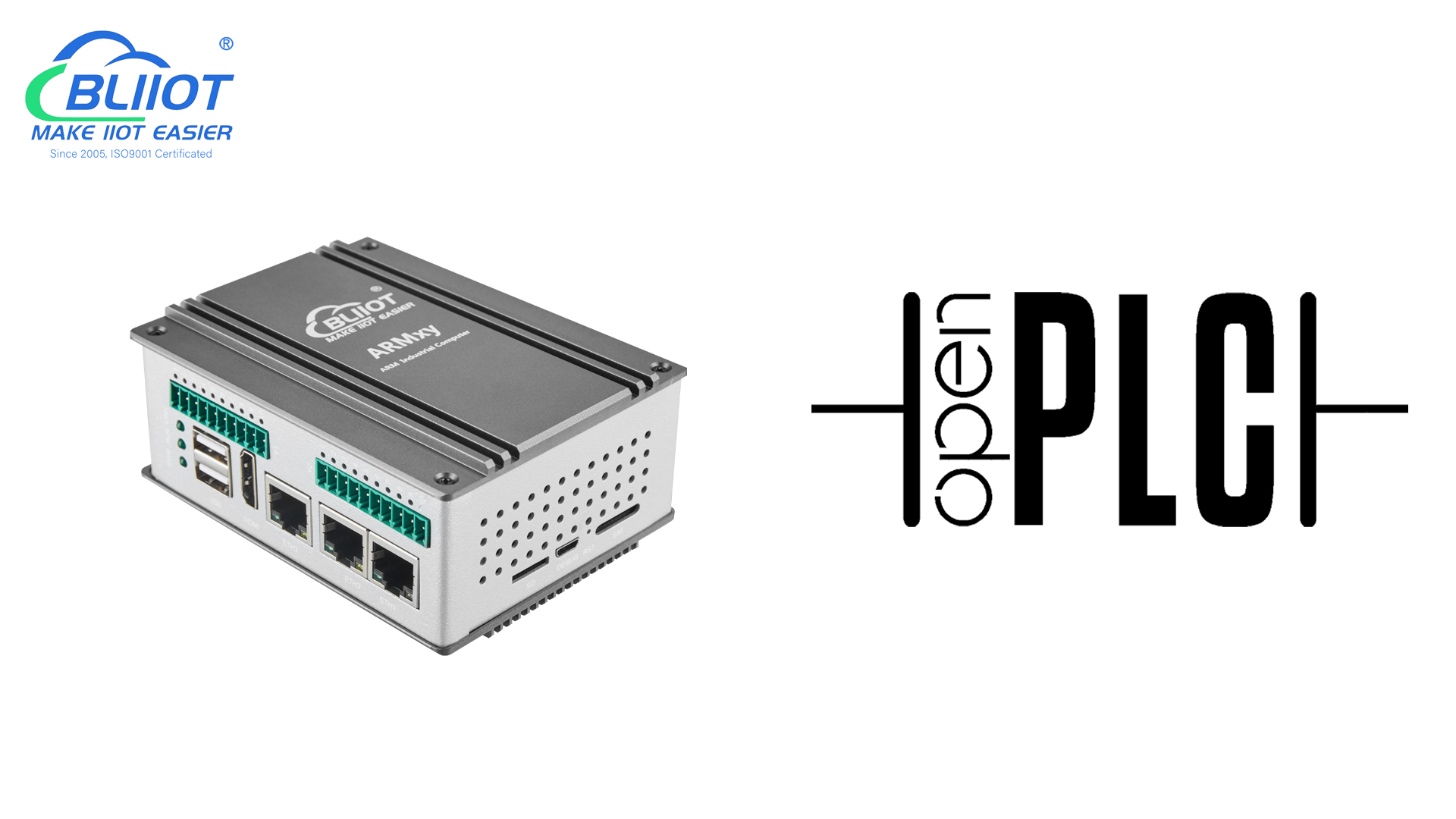
ARM Industrial Computers & OpenPLC: Redefining Industrial Automation
Categories

ARM Industrial Computers ARMxy & OpenPLC: Redefining Cost-Efficient Industrial Automation

The combination of ARM industrial computers and OpenPLC provides a cost-effective "lightweight PLC" solution for industrial control, realizing industrial scene logic control (IEC 61131-3 Programming)
ARM Industrial Computers ARMxy & OpenPLC: Redefining Cost-Efficient Industrial Automation
Case Details

1. Characteristics and Advantages of ARM Industrial Computers

  • Low Power Consumption, High Performance
    ARM-based processors (e.g., Cortex-A series) deliver strong computational capabilities with low power consumption, ideal for industrial scenarios requiring continuous operation.

  • Rich Interface Support
    Supports industrial communication interfaces such as GPIO, CAN, RS-485, Ethernet, and USB, enabling direct connectivity to sensors, actuators, and industrial bus devices.

  • Compact and Rugged Design
    Industrial-grade construction (wide temperature tolerance, vibration resistance, dustproof) ensures reliability in harsh environments, with a small form factor for embedded deployment.

  • Linux/RTOS Compatibility
    Runs Linux (e.g., Debian, Ubuntu Core) or real-time operating systems (e.g., FreeRTOS) to meet real-time requirements.


2. Core Features of OpenPLC

  • Open Source and Cross-Platform
    Complies with IEC 61131-3 standards, supporting programming languages like Ladder Logic and Structured Text (ST), and runs on Windows/Linux/Raspberry Pi platforms.

  • Flexible Deployment
    Compatible with x86/ARM hardware, deployable as a soft PLC (on general-purpose computers) or hard PLC (e.g., Raspberry Pi, ARM industrial PCs).

  • Protocol Compatibility
    Built-in support for Modbus TCP/RTU, MQTT, OPC UA, and other protocols, facilitating integration with SCADA, HMI, and cloud systems.

  • Extensibility
    Allows custom function blocks via Python/C++ to integrate AI algorithms or third-party libraries.


3. Typical Application Scenarios for ARM + OpenPLC

3.1 Automation of Small to Medium-Sized Production Lines

  • Example: Food Packaging Machinery Control

    • ARM industrial PC (e.g., NXP i.MX8) runs OpenPLC to control servo motors and pneumatic cylinders via Modbus RTU.

    • HMI touchscreens interact with OpenPLC via Modbus TCP for real-time monitoring.

  • Advantages: Costs 1/3 of traditional PLC solutions, with support for custom algorithms (e.g., visual quality inspection).

3.2 Distributed Energy Management

  • Example: Photovoltaic Power Station Monitoring

    • ARM gateway (e.g., Allwinner T507) runs OpenPLC to collect inverter data (RS-485) and upload it to the cloud via MQTT.

    • Local logic control (e.g., battery charge/discharge strategies) is executed directly by OpenPLC.

  • Advantages: Edge computing reduces cloud workload and supports offline operation.

3.3 Smart Warehouse Systems

  • Example: AGV Scheduling Control

    • Multiple ARM industrial PCs (e.g., Rockchip RK3568) run OpenPLC to coordinate AGV paths via CAN bus.

    • Integrates ROS nodes for SLAM navigation, with OpenPLC handling motor control and obstacle avoidance.

  • Advantages: Unified hardware-software design simplifies multi-device coordination.

    4. Comparison with Traditional PLC Solutions

    Aspect ARM + OpenPLC Traditional PLC (e.g., Siemens S7-1200)
    Cost Hardware cost reduced by over 50% High hardware/licensing fees
    Customization Deep customization (drivers/algorithms) Closed ecosystem, vendor-dependent
    Ecosystem Seamless Python/Node.js integration Limited to TIA Portal/CODESYS
    Use Cases SMEs, R&D, rapid prototyping Large-scale, high-reliability systems

    5. Challenges and Mitigation Strategies

    • Real-Time Limitations: ARM + Linux lacks native real-time performance; use kernel patches or FPGA coprocessors.

    • Long-Term Maintenance: Open-source version updates may cause compatibility issues; lock versions and maintain forks.

    • Security Risks: Harden Linux systems (e.g., disable default SSH ports, enable SELinux).


    6. Conclusion

    The combination of ARM industrial computers and OpenPLC offers a cost-effective, lightweight PLC solution for industrial automation, particularly suited to scenarios requiring rapid iteration and customization (e.g., smart agriculture, lab equipment). For mission-critical environments (e.g., nuclear plants, railways), traditional PLC reliability must still be evaluated. As the ARM ecosystem matures (e.g., RISC-V industrial chips), this approach is poised to expand further into industrial markets.

Want Solution?

Request a similar solution today?
Try it Now

Propular Products

VIEW ALL PRODUCTS
We use Cookie to improve your online experience. By continuing browsing this website, we assume you agree our use of Cookie.