ARM Embedded gateways provide an integrated solution for real-time monitoring, intelligent control, secure communication, and efficient maintenance in tunnel monitoring systems.
Case Details
With the acceleration of urbanization, tunnel engineering has become increasingly common in transportation infrastructure. The enclosed environment inside tunnels is susceptible to factors such as exhaust gases, smoke, and fluctuations in temperature and humidity, posing higher demands on ventilation, safety, and operational maintenance. Traditional monitoring systems often rely on centralized control rooms, lacking real-time responsiveness and flexibility. ARM embedded gateways, with their low power consumption, high performance, rich interfaces, and edge computing capabilities, have become critical supporting devices for tunnel monitoring systems.
System Architecture
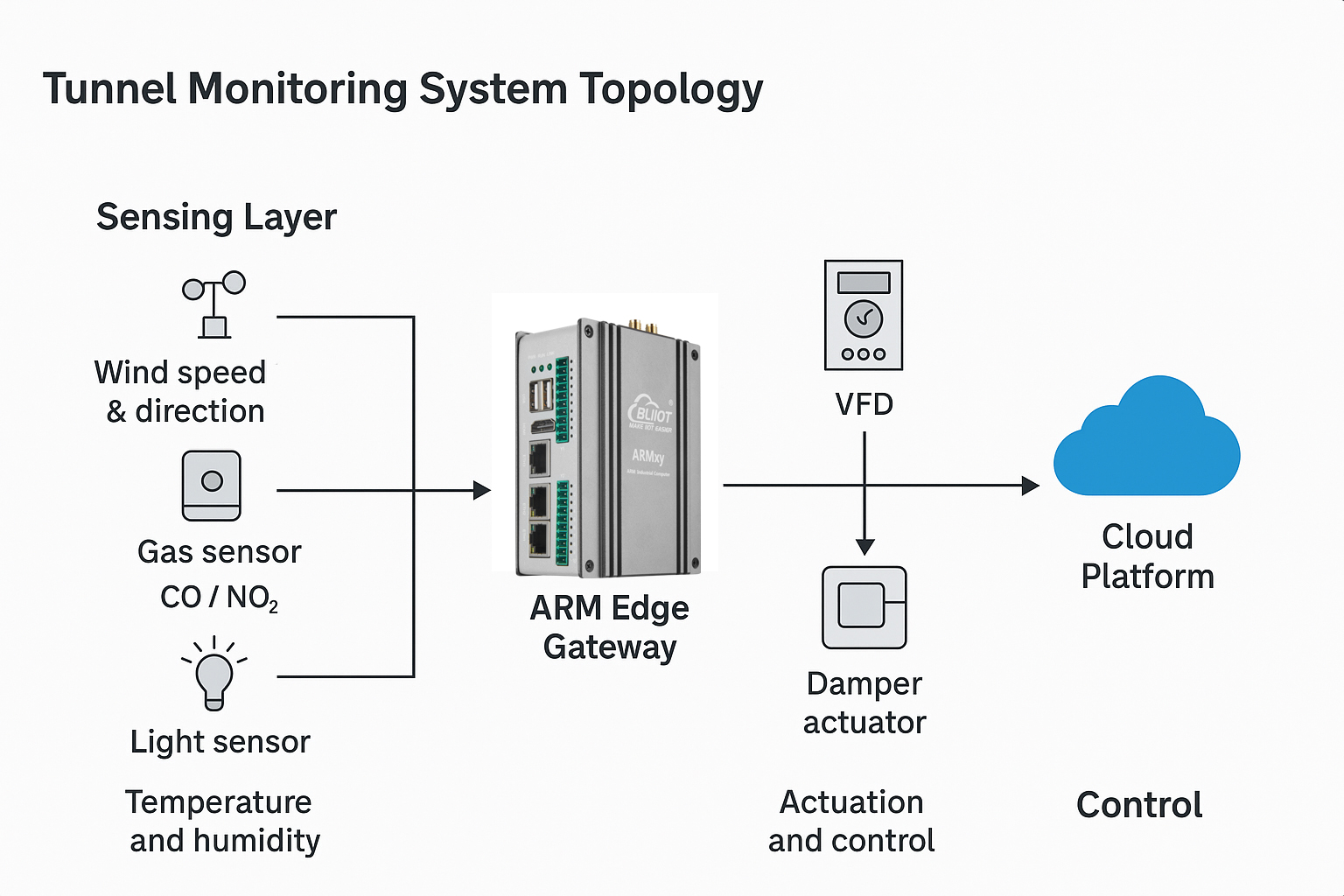
A tunnel monitoring system typically comprises the following layers: sensor layer, edge processing layer (ARM gateway), execution and control layer, and cloud/central layer.
Sensor Layer
-
Wind Speed and Direction Sensors: Monitor air flow within the tunnel.
-
Gas Sensors: Detect CO and NO₂ concentrations to ensure personnel safety.
-
Illuminance Sensors: Monitor tunnel lighting conditions.
-
Temperature and Humidity Sensors: Provide data for environmental regulation and equipment operation.
-
Data Acquisition: Collects data from various sensors via interfaces such as RS485, CAN, 4–20mA, and Ethernet.
-
Edge Computing: Performs local data cleaning, denoising, and anomaly detection to reduce unnecessary data uploads.
-
Real-Time Alerts: Issues immediate alerts and activates fans or dampers when CO/NO₂ levels or wind speeds exceed thresholds.
-
Multi-Protocol Support: Supports Modbus, BACnet, MQTT, and OPC UA for compatibility with PLC, SCADA, and cloud platforms.
Execution and Control Layer
-
VFD (Variable Frequency Drive) Fans: Adjust fan speed based on commands from the ARM gateway.
-
Damper Actuators: Regulate airflow direction to optimize ventilation.
-
Lighting Control: Automatically adjusts light intensity for energy savings and safety.
Cloud Platform and Monitoring Center
-
Data storage and historical analysis.
-
Visualization dashboards and remote maintenance.
-
AI and big data integration for trend prediction and equipment health diagnostics.
Application Advantages
High Real-Time Performance
ARM gateways enable on-site data acquisition and preliminary processing, significantly reducing cloud latency and improving alert and linkage efficiency.
High Reliability
Industrial-grade ARM gateways support wide-temperature operation (-40°C to 85°C) and dust/moisture-resistant designs, adapting to harsh tunnel environments.
Flexible Scalability
Modular I/O and wireless communication capabilities (4G/5G, Wi-Fi) allow flexible expansion based on project needs.
Security Assurance
Supports TLS/SSL encrypted transmission, VPN secure access, and firmware signature verification to ensure the security of tunnel data and control links.
Efficient Maintenance
Remote upgrades (OTA), log collection, and intelligent alert notifications reduce manpower and maintenance costs for tunnels.
Typical Application Scenarios
-
Highway Tunnels: Real-time monitoring of exhaust gas concentrations and ventilation efficiency to ensure traffic safety.
-
Subway Tunnels: Optimize train operating environments for passenger comfort and equipment stability.
-
Underground Utility Corridors: Detect hazardous gases and provide fire/explosion prevention for municipal network operations.
-
Underground Parking Garages: Monitor exhaust gases and air quality, intelligently activating ventilation systems.
Conclusion
ARM Embedded gateways, with their powerful edge computing, low power consumption, and versatile interfaces, provide an integrated solution for real-time monitoring, intelligent control, secure communication, and efficient maintenance in tunnel monitoring systems. In the future, as AI and 5G technologies advance, ARM gateways will play an increasingly vital role in smart transportation and urban infrastructure monitoring.


