ARM Embedded edge computers will not only monitor environmental conditions but also perform real-time analysis of process imagery and machinery status, evolving into "multimodal intelligent edge nodes."
Case Details
In 3C (Computer, Communication, Consumer Electronics) manufacturing workshops, environmental parameters such as temperature, pressure, and humidity directly impact product quality. Excessive humidity can cause components to absorb moisture, affecting soldering quality, while abnormal pressure or temperature can destabilize production processes. Traditionally, sensor data is uploaded to the cloud for centralized analysis, but this approach heavily relies on network connectivity, introducing latency, bandwidth consumption, and risks of network disconnection.
With the rise of edge computing, ARM embedded edge computers have become a critical infrastructure for intelligent manufacturing. They enable local analysis and decision-making for multi-sensor data directly at the workshop, delivering low-latency, high-reliability data processing.
System Architecture
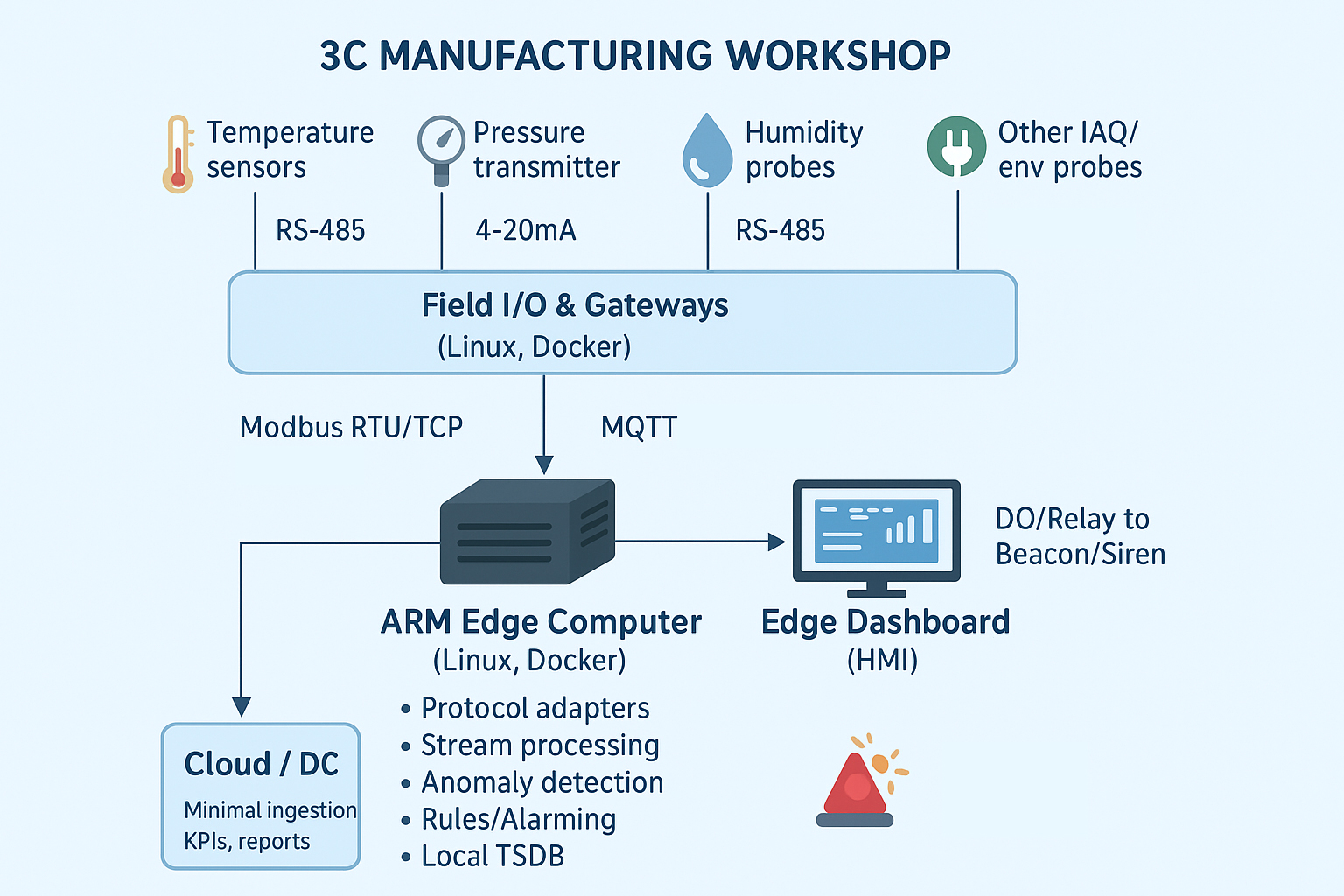
In 3C manufacturing workshops, sensors such as temperature probes, pressure transmitters, and humidity sensors are connected to ARM embedded edge computers via interfaces like RS-485, 4-20mA These edge computers run on Linux systems and are equipped with algorithms for data acquisition, cleaning, feature extraction, and anomaly detection.
-
Data Acquisition: Supports multiple protocols (Modbus RTU/TCP) for seamless integration of diverse sensors.
-
Local Analysis: Utilizes rule-based engines and lightweight machine learning models for anomaly detection and trend prediction.
-
Real-Time Alerts: When temperature, pressure, or humidity exceeds predefined thresholds, the edge computer triggers local audible-visual alarms or activates equipment like fans or dehumidifiers.
-
Local Storage and Visualization: Features built-in time-series databases and visualization interfaces, allowing operators to view trends and alarm records directly on workshop terminals.
-
Cloud Integration: Only critical metrics and aggregated data are uploaded to the cloud, reducing bandwidth usage while ensuring continuous operation during network outages.
Application Value
-
Reduced Cloud Dependency: Data analysis and alerts are processed locally, ensuring production continuity and process stability even during network interruptions.
-
Lower Latency: Local decision-making is completed in milliseconds, preventing quality issues due to cloud processing delays.
-
Bandwidth and Cost Savings: By uploading aggregated results and events instead of raw sensor data, network and cloud storage costs are significantly reduced.
-
Improved Yield: Real-time correlation of environmental parameters with quality data enables engineers to quickly identify issues, preventing batch defects.
-
Flexible Scalability: ARM edge computers support containerized applications, allowing easy integration of new algorithms or interface protocols to adapt to evolving workshop processes.
Future Outlook
As 3C manufacturing advances toward intelligence and automation, edge computing will increasingly integrate with AI. In the future, ARM embedded edge computers will not only monitor environmental conditions but also perform real-time analysis of process imagery and machinery status, evolving into "multimodal intelligent edge nodes."
This will transform manufacturing workshops from single-purpose monitoring to intelligent collaboration, achieving higher levels of yield optimization, energy management, and predictive maintenance. These advancements will provide robust support for the 3C industry to maintain a competitive edge in the global market.


