ARM edge controllers bring higher levels of automation and intelligence to fire systems. Through real-time monitoring, intelligent integration, and remote management, these systems enable rapid responses during the early stages of a fire, ensuring the safety of lives and property.
Case Details
In modern smart buildings and industrial facilities, fire safety is a critical component. Traditional fire systems, primarily focused on standalone alarms, often face issues such as response delays and limited integration. With the advancement of IoT and edge computing technologies, ARM-based edge controllers have been widely adopted in fire systems, enabling multi-sensor fusion, intelligent integration, and remote monitoring. This significantly enhances the reliability and automation of fire protection systems.
System Functions and Application Scenarios
ARM Edge controllers BL360 Series, with their high performance, low power consumption, and versatile interfaces, are integrated into fire systems across various settings, including buildings, data centers, underground utility corridors, and logistics warehouses. Their key functions include:
Real-Time Monitoring
-
Collects data from smoke sensors, temperature sensors, and hazardous gas sensors (e.g., carbon monoxide, methane).
-
Utilizes edge computing for rapid local analysis, ensuring real-time and accurate data processing.
Intelligent Integration
-
Automatically activates audio-visual alarms and emergency broadcast systems upon detecting fire hazards or excessive gas concentrations.
-
Controls fire sprinkler systems, exhaust fans, and ventilation systems for comprehensive fire response integration.
Data Processing and Upload
-
Performs local data filtering and preliminary analysis to minimize false alarms and missed detections.
-
Uploads event data and alerts to building management platforms or the cloud via Ethernet, Wi-Fi, 4G/5G, or MQTT protocols.
Remote Maintenance
-
Enables firefighters to monitor system status in real time via mobile devices or control centers.
-
Supports remote debugging, data log tracing, and equipment health diagnostics.
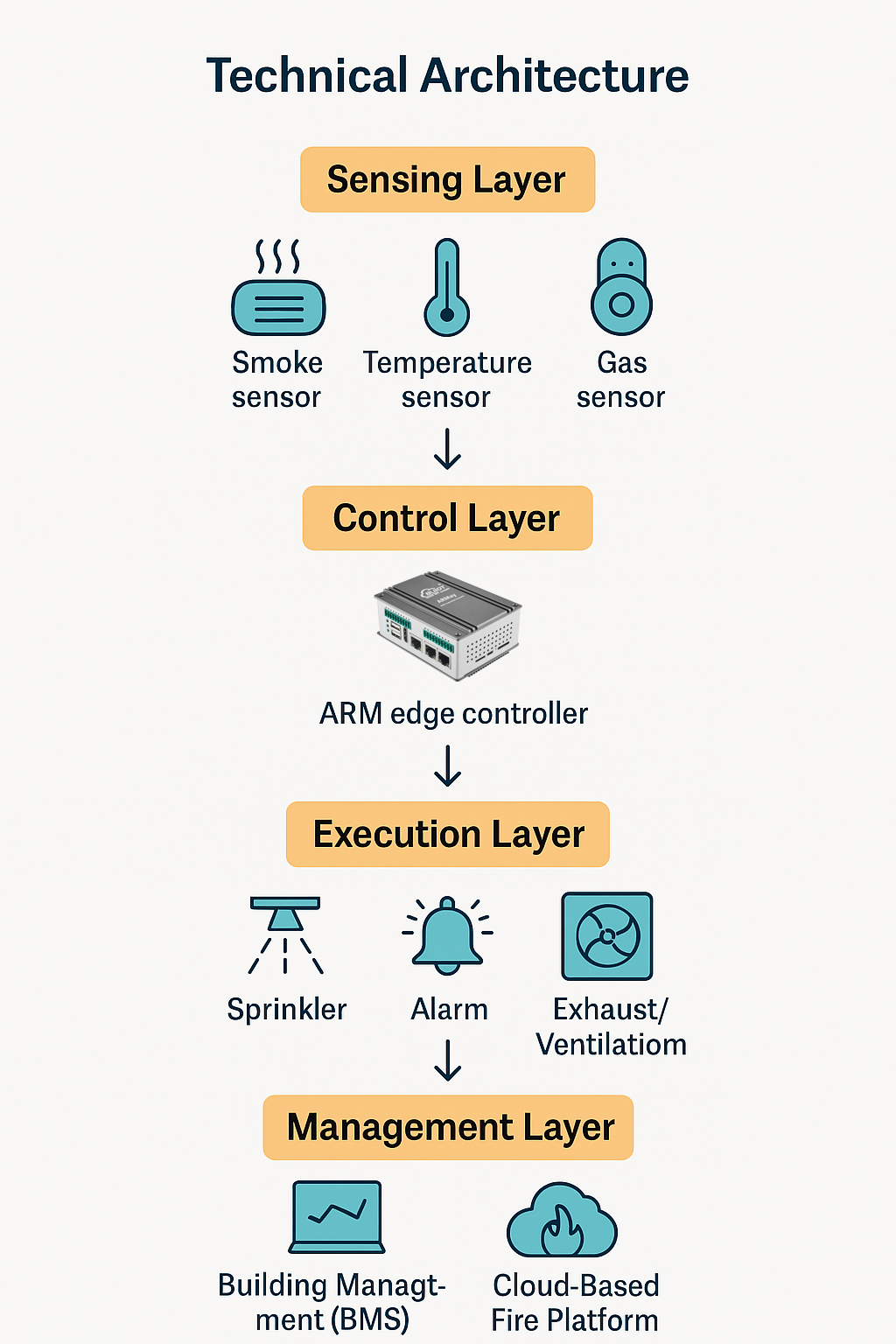
Technical Architecture
The system is structured into four layers:
-
Sensing Layer: Comprises various sensors, including smoke, temperature, and gas detectors.
-
Control Layer: The ARM edge controller serves as the core, handling data collection, logical operations, and integration execution.
-
Execution Layer: Includes sprinkler systems, alarm systems, and exhaust/ventilation equipment.
-
Management Layer: Building Management System (BMS) or cloud-based fire platforms for remote monitoring and centralized management.
Application Value
-
Rapid Response: Triggers alarms and sprinklers within milliseconds, minimizing fire-related losses.
-
Intelligent Decision-Making: Enhances system reliability by reducing false alarms through multi-source data fusion and edge computing.
-
Safety Assurance: Protects personnel and assets, elevating overall fire safety standards.
-
Efficient Maintenance: Supports remote diagnostics and platform-based operations, reducing labor costs.
Conclusion
ARM edge controllers bring higher levels of automation and intelligence to fire systems. Through real-time monitoring, intelligent integration, and remote management, these systems enable rapid responses during the early stages of a fire, ensuring the safety of lives and property. As smart cities and industrial IoT continue to evolve, ARM-based intelligent fire solutions will see broader adoption across diverse scenarios.


