ARM Cortex-A55 Embedded Controller BL410 is applied to photovoltaic (PV) energy storage systems to combine solar power generation with battery energy storage to provide reliable and efficient energy solutions
Case Details
Introduction
Photovoltaic (PV) energy storage systems integrate solar power generation with battery storage to provide a reliable and efficient energy solution. These systems require robust monitoring and control to ensure optimal performance, safety, and longevity. The ARMxy Cortex-A55 Embedded Controller BL410 is an ideal solution for such applications. With its high-performance processor, flexible I/O configurations, and industrial-grade reliability, the ARMxy BL410 meets the demanding requirements of PV energy storage cabinet monitoring. This article explores how the ARMxy BL410 can be applied to monitor critical data in PV energy storage systems, highlighting its hardware and software capabilities.
System Requirements for PV Energy Storage Cabinets
A PV energy storage cabinet integrates components such as batteries, inverters, energy management systems (EMS), and safety devices. Effective monitoring requires collecting and analyzing data from various subsystems, including:
-
Battery Status: Voltage, current, state of charge (SOC), state of health (SOH), and temperature.
-
PV Generation: Output power, voltage, current, and daily energy yield.
-
Inverter Performance: Input/output power, efficiency, and fault status.
-
Grid Interaction: Grid power, voltage, frequency, and power factor.
-
Load Data: Real-time power consumption and load type prioritization.
-
Environmental Conditions: Cabinet temperature, humidity, and external weather data.
-
Safety Parameters: Smoke detection, vibration, and unauthorized access.
The system must also support real-time data processing, remote monitoring, and seamless integration with cloud platforms, all while operating reliably in harsh industrial environments.
ARMxy BL410 Embedded Controller: Hardware Configuration
The ARMxy BL410 series, powered by the Rockchip RK3568J/RK3568B2 quad-core ARM Cortex-A55 processor (up to 2.0 GHz), is designed for industrial IoT applications, including PV energy storage. Its key hardware features make it well-suited for monitoring and control tasks:
1. Processor and Storage
-
System-on-Module (SOM): The SOM412 model (RK3568J, 1.8 GHz, 32GB eMMC, 4GB LPDDR4X) provides ample computing power and storage for data logging and edge computing.
-
Neural Processing Unit (NPU): With 1TOPS computing power, it supports AI-based tasks like battery health prediction and fault diagnostics.
2. Communication Interfaces
-
Ethernet: The BL412 model offers three 10/100M Ethernet ports for robust connectivity with inverters, EMS, and cloud platforms.
-
Wireless: A Mini PCIe slot supports 4G and WiFi modules, with a NANO SIM slot for cellular connectivity, enabling remote monitoring.
-
Serial and Fieldbus: X-series I/O boards (e.g., X23 with 4xRS485) support Modbus, CAN, and other protocols for communication with battery management systems (BMS) and inverters.
3. I/O Configuration
-
X-Series I/O Board (X23): Provides 4xRS485, 4xDI, and 4xDO for serial communication, switch status monitoring (e.g., circuit breakers), and control (e.g., relays).
-
Y-Series I/O Boards:
-
Y51 (2xRTD, 3-wire PT100): Monitors battery and cabinet temperatures.
-
Y31 (4xAI, 0/4-20mA): Measures analog signals like battery voltage and current.
-
Y24 (4xDO, Relay): Controls cooling fans or fire suppression systems.
-
Scalability: Supports multiple I/O boards, allowing customization based on system scale.
Power and Installation
-
Power Supply: Supports 9-36V DC with reverse polarity and overcurrent protection, compatible with PV system power environments.
-
Mounting: DIN35 rail mounting ensures easy integration into energy storage cabinets.
-
Environmental Resilience: Operates in -40°C to 85°C, with IP30 protection against dust, meeting outdoor and industrial requirements.
5. Reliability
-
Electromagnetic Compatibility (EMC): Passes GB/T 9254 and IEC 61000 standards for ESD, EFT, and surge immunity, ensuring stable operation in electrically noisy environments.
-
Environmental Testing: Complies with GB/T 2423 and IEC 60068 for high/low-temperature, humidity, vibration, and drop tests, ensuring durability.
Software Capabilities for Monitoring
The ARMxy BL410 supports a versatile software ecosystem that simplifies development, data acquisition, and cloud integration:
1. Operating Systems and Development Tools
-
OS Support: Runs Linux-5.10.209, Ubuntu 20.04, providing a stable platform for industrial applications.
-
Qt-5.15.2: Enables development of local human-machine interfaces (HMIs) for real-time data visualization.
-
Node-Red: Facilitates rapid development of IoT workflows for data collection and control logic.
2. Protocol Conversion and Cloud Integration
-
BLIIoTLink Software: Supports industrial protocols (Modbus, MQTT, OPC UA) for seamless integration with BMS, inverters, and EMS. It also connects to cloud platforms like AWS IoT Core, Thingsboard, and Alibaba IoT.
-
Docker Support: Allows deployment of containerized applications for scalability and maintenance.
3. Remote Access
-
BLRAT Software: Enables remote device access for maintenance, firmware updates, and troubleshooting, reducing on-site service costs.
Monitoring Critical Data with ARMxy BL410
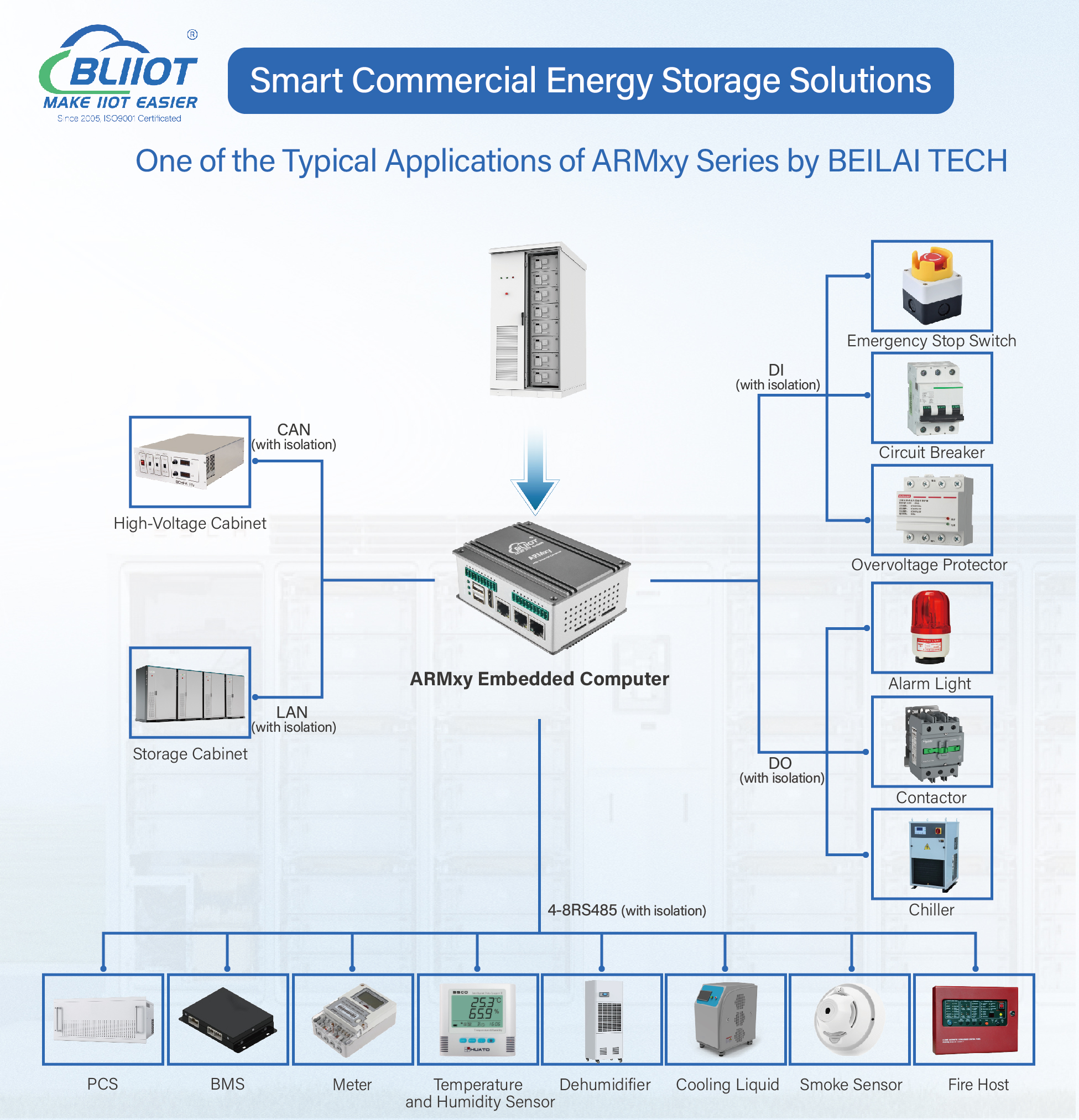
The ARMxy BL410 can comprehensively monitor all required data in a PV energy storage cabinet:
1. Battery Status
-
Voltage and Current: Y31 (4xAI) captures analog signals from battery sensors.
-
SOC and SOH: RS485 (X23) retrieves data from the BMS, with NPU processing for SOH predictions.
-
Temperature: Y51 (RTD) monitors battery and cabinet temperatures to prevent overheating.
2. PV Generation
-
Power, Voltage, and Current: RS485 connects to inverters, while Y31 measures DC-side parameters.
-
Daily Yield: EMS software aggregates generation data stored in eMMC.
3. Inverter Performance
-
Power and Efficiency: RS485 retrieves inverter metrics, with EMS calculating efficiency.
-
Faults: DI (X23) detects alarm signals, or RS485 reads fault codes.
4. Grid and Load
-
Grid Parameters: RS485 or Y31 interfaces with smart meters for voltage, frequency, and power factor.
-
Load Power: Y31 measures consumption, with EMS prioritizing critical loads.
5. Environmental and Safety
-
Temperature and Humidity: Y51 and external sensors monitor cabinet conditions.
-
Safety: DI (X23) connects to smoke detectors, vibration sensors, and door switches for fire, structural, and security monitoring.
6. System Status
-
Operating Mode: EMS tracks grid-connected, off-grid, or charging modes.
-
Alarms and Logs: DI captures alarms, with eMMC storing historical data for analysis.
Implementation Example
For a 100kW PV energy storage cabinet, the following BL410 configuration is recommended:
-
Model: BL412B-SOM412-X23-Y31-Y51 (3xEthernet, 32GB eMMC, 4GB RAM, 4xRS485, 4xAI, 2xRTD).
-
Wireless: Add 4G module (BL412L) for cloud connectivity.
-
Software: Deploy Ubuntu 20.04 with BLIoTLink for Modbus-to-MQTT conversion, Node-Red for data workflows, and Qt for a local HMI.
-
Connections:
-
RS485 to BMS, inverter, and smart meter.
-
AI for battery voltage/current, RTD for temperature.
-
DI/DO for alarms and relay control.
-
Cloud Integration: Use Thingsboard for real-time dashboards and alerts.
This setup ensures comprehensive monitoring, remote access, and compliance with safety standards like GB/T 36276.
Advantages of ARMxy BL410 in PV Energy Storage
-
Flexibility: Customizable I/O boards support diverse signal types, adapting to various system configurations.
-
Connectivity: Multiple Ethernet ports, 4G/WiFi, and protocol support ensure seamless device and cloud integration.
-
Reliability: Industrial-grade design with EMC and environmental certifications guarantees uptime in harsh conditions.
-
Edge Intelligence: NPU and Docker enable on-device analytics, reducing cloud dependency.
-
Ease of Use: Pre-installed software, development kits, and examples accelerate deployment.
Conclusion
The ARMxy Embedded Controller BL410 embedded controller is a powerful and versatile solution for monitoring PV energy storage cabinets. Its robust hardware, flexible I/O, and comprehensive software ecosystem enable precise data acquisition, real-time control, and cloud integration. By addressing the critical monitoring needs of batteries, PV generation, inverters, and safety systems, the BL410 ensures efficient, reliable, and safe operation of PV energy storage systems. For developers and system integrators, the BL410 offers a scalable and future-proof platform to meet the evolving demands of renewable energy applications.


