ARM Controllers empower HVAC operations with efficient, reliable solutions to achieve energy-efficient, comfortable, and sustainable building environments.
Case Details
In modern buildings, the reliable operation of Heating, Ventilation, and Air Conditioning (HVAC) systems is critical for ensuring occupant comfort and energy efficiency. Preventive maintenance and system health checks are essential to achieving these objectives. With their high performance, low power consumption, and multi-protocol support, ARM controllers have become the cornerstone of HVAC systems, providing robust technical support for intelligent operations.
Application Context
HVAC systems regulate temperature, humidity, and air quality within buildings, accounting for a significant portion of energy consumption. Equipment aging, performance degradation, or unexpected failures can lead to increased energy use, reduced comfort, or system downtime. By leveraging ARM controllers for regular system health checks and preventive maintenance, potential issues can be identified and addressed proactively, minimizing risks and extending equipment lifespan.
Control Room Workflow
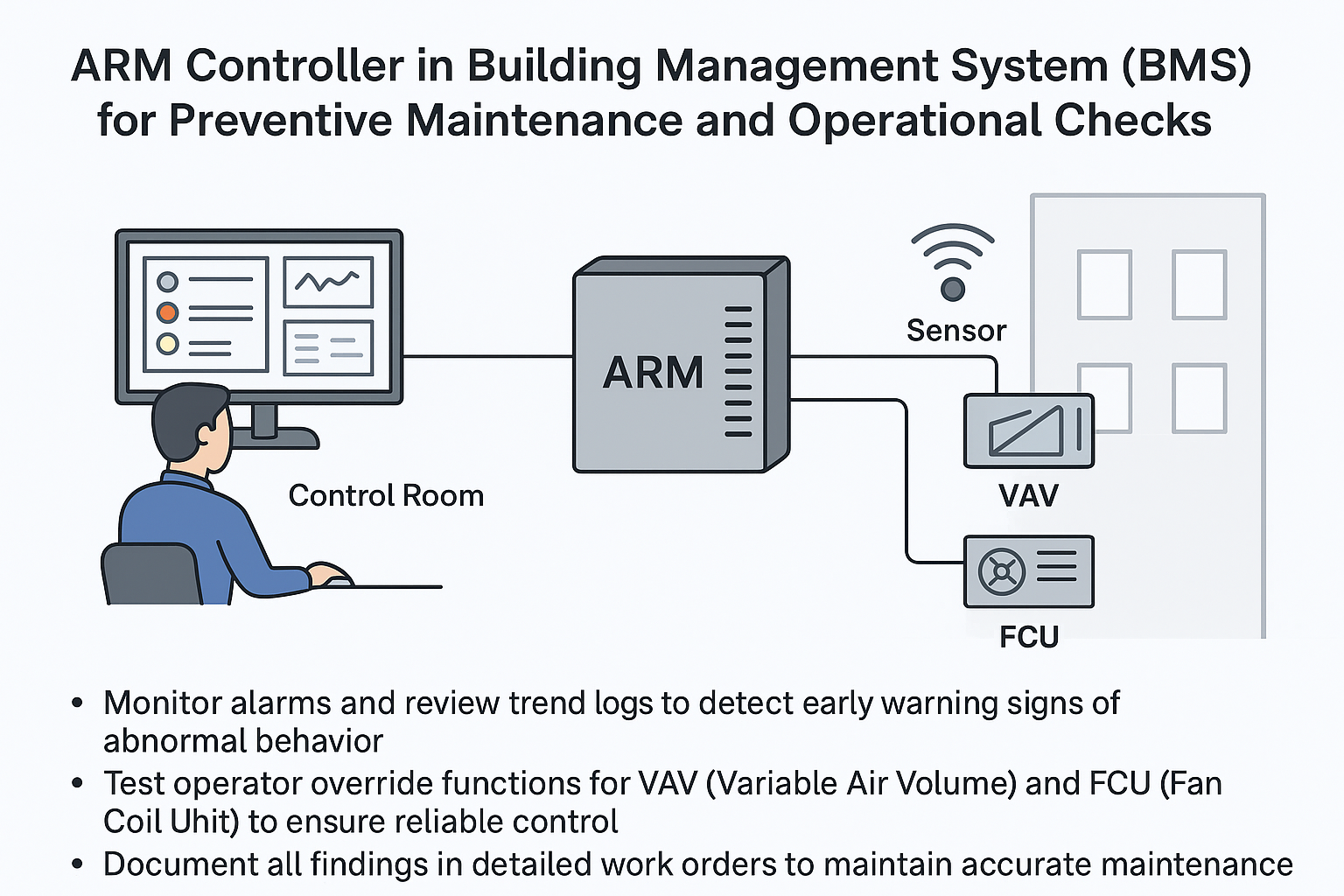
Real-Time Monitoring and Trend Analysis
ARM controllers collect real-time data from sensors monitoring temperature, humidity, air quality, pressure, and flow rates, which are visualized on the HVAC control platform. Operators can use trend logs and data analytics tools to monitor equipment performance, identify anomalies (e.g., abnormal energy spikes or operational deviations), and take preemptive actions to prevent issues.
Functional Testing and Remote Control
During preventive maintenance, operators can remotely conduct functional tests on systems such as Variable Air Volume (VAV) units, Fan Coil Units (FCUs), and cooling towers via the HVAC control platform. These tests verify equipment performance under various conditions, ensuring stable responses to control commands and identifying potential mechanical or electrical issues.
Maintenance Records and Work Order Management
ARM controllers enable the automatic generation of inspection reports and maintenance work orders, documenting test results, anomalies, and corrective actions. These records form a historical database, providing a valuable reference for future maintenance and supporting long-term performance optimization and equipment management decisions.
-
Multi-Protocol Support: Compatible with protocols such as Modbus, BACnet, and MQTT, ARM controllers seamlessly integrate with HVAC equipment from various manufacturers, enhancing system flexibility and scalability.
-
Edge Computing Capabilities: ARM controllers perform local data processing and anomaly detection, reducing reliance on cloud computing, improving response times, and lowering network loads.
-
Low Power Consumption and High Reliability: Designed for 24/7 operation, ARM controllers deliver high performance while minimizing energy use, meeting the demands of continuous HVAC system operations.
-
Modular Design: Supports hardware expansion and software upgrades, ensuring adaptability to future technological advancements and functional requirements.
Application Benefits
By integrating ARM controllers into HVAC systems, operations teams can achieve the following benefits:
-
Reduced Risk of Failures: Real-time monitoring and trend analysis enable early detection and resolution of equipment anomalies, minimizing unexpected downtime.
-
Optimized Energy Efficiency: Data-driven equipment optimization strategies significantly reduce energy consumption and operational costs.
-
Enhanced Occupant Experience: Stable equipment performance and precise environmental control improve indoor comfort and user satisfaction.
-
Support for Sustainability: By extending equipment lifespan and optimizing resource use, ARM controllers contribute to green building operations.
Conclusion
With their high performance, low power consumption, multi-protocol compatibility, and edge computing capabilities, ARM controllers are indispensable in modern HVAC systems. By enabling real-time monitoring, functional testing, and intelligent maintenance management, ARM controllers empower HVAC operations with efficient, reliable solutions to achieve energy-efficient, comfortable, and sustainable building environments.


