ARM industrial computers undertake intelligent tasks such as precise advertising delivery and real-time audience analysis, driving the digital signage industry into a new era.
Case Details
With the rise of smart cities and commercial complexes, digital signage has gradually replaced traditional posters and lightboxes, becoming the mainstream advertising display method in malls, subway stations, airports, office buildings, and outdoor media. In this context, ARM Linux industrial PCs serve as the core control unit, providing stable, low-power, and intelligent hardware support for digital signage systems.
System Architecture
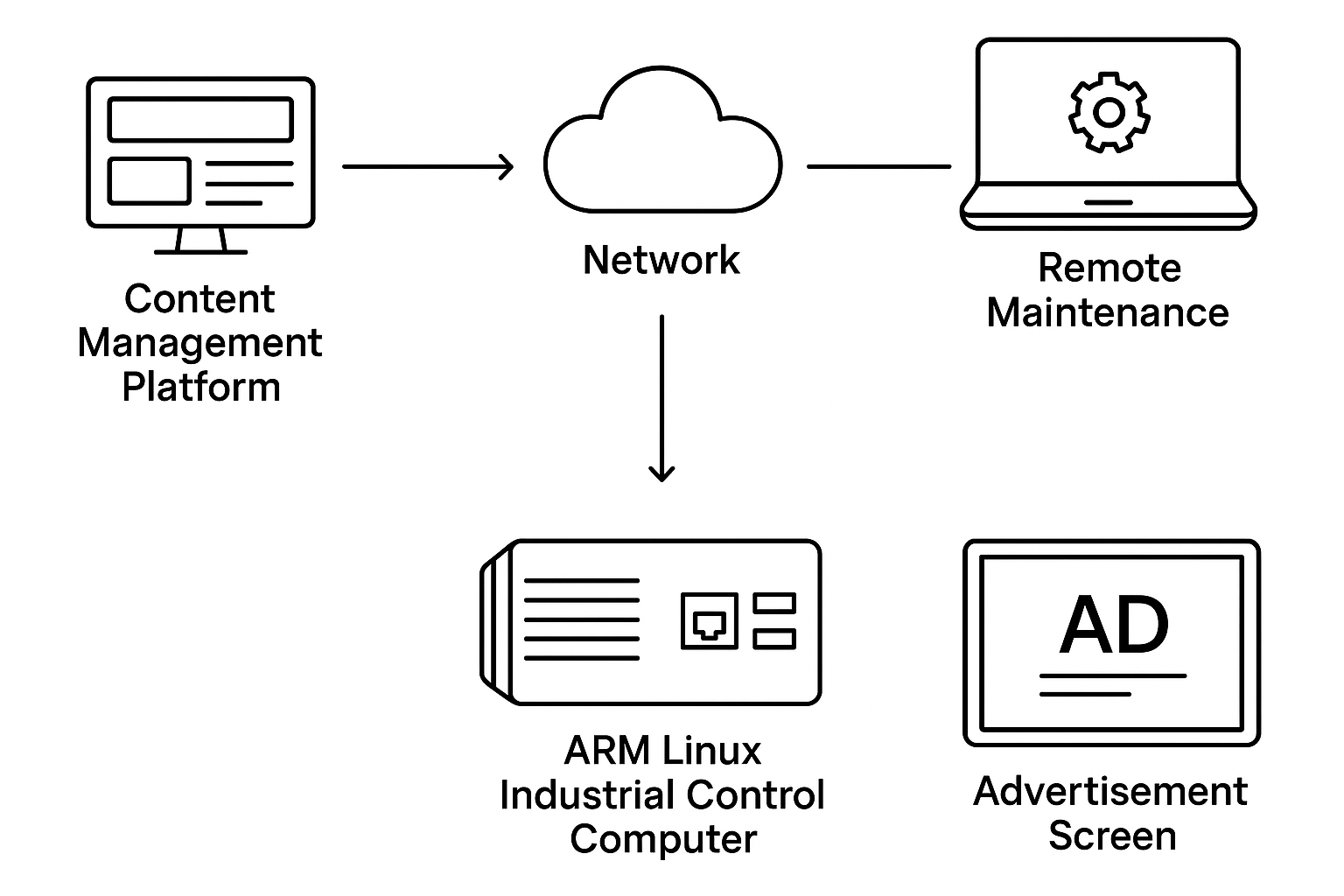
A digital signage system typically consists of a display terminal, content management platform, network communication module, and control host. The ARM Linux industrial PC, as the playback control host, plays a pivotal role:
-
Content Reception and Storage: Retrieves images, videos, and text information from the content management platform via Ethernet, 4G/5G, or Wi-Fi.
-
Local Decoding and Playback: Equipped with multimedia hardware acceleration, it supports high-definition video decoding (e.g., H.264/H.265) on a low-power ARM platform.
-
Timing and Task Scheduling: Utilizes the Linux system's task scheduling capabilities for timed content switching and automated playback.
-
Multi-Screen Synchronization: Supports multiple HDMI/DP interface outputs to control video walls or synchronize playback across multiple terminals.
-
Remote Maintenance: Enables VPN and secure tunnels for remote monitoring of device status, content updates, and playback data analytics by operators.
Application Advantages
-
Low Power Consumption and High Stability: The ARM architecture offers high energy efficiency and low heat generation, ideal for 7×24 continuous operation, reducing operational energy costs.
-
Open Linux Platform: Based on Linux, it supports customized playback software and content management clients, compatible with various programming languages and extensible applications.
-
Cost-Effectiveness: Compared to traditional x86-based players, ARM Linux industrial PCs are more affordable, making them suitable for large-scale deployments.
-
Flexible Interfaces: Supports HDMI/VGA/DP video outputs, USB peripheral connections, and RS485/Ethernet communication, adaptable to diverse signage displays and environments.
-
Edge Intelligence: High-performance ARM industrial PCs can integrate AI modules for features like foot traffic recognition, audience analysis, and precise ad targeting, enhancing advertising value.
Typical Application Scenarios
-
Malls and Retail Stores: Displays promotional content and brand videos to attract customer attention.
-
Subways, Airports, and Stations: Delivers real-time advertisements and transit information with synchronized updates.
-
Office Buildings and Hotel Lobbies: Shows corporate promotions, welcome messages, or advertising content.
-
Outdoor Billboards: Plays high-definition videos on large LED screens with remote content updates.
-
Smart Campuses and Hospitals: Publishes notifications and educational videos for efficient information management.
Conclusion
With its stability, low power consumption, and flexible scalability, the ARM Linux industrial PC has become an ideal hardware platform for digital signage systems. As 5G, AI, and big data technologies advance, ARM industrial PCs will evolve beyond mere playback controllers, taking on intelligent tasks such as precise ad targeting and real-time audience analysis, driving the digital signage industry into a new era.


