The integration of ARM controllers transforms hydroponics from passive monitoring to active intelligent control.
With strong computational performance, low power consumption, and edge AI capability, ARM controllers are becoming the central brain of smart agriculture and circular ecosystems.
Case Details
As modern agriculture moves toward intelligence and sustainability, Hydroponics, a hybrid system that combines aquaculture and plant cultivation, has become an important direction for future farming.
However, Hydroponics systems are highly sensitive to water conditions. Parameters such as temperature, pH, dissolved oxygen (DO), electrical conductivity (EC), and ammonia levels must be continuously monitored and dynamically regulated. Traditional manual monitoring is inefficient and error-prone, making it difficult to manage complex environments.
Therefore, integrating an ARM-based intelligent controller has become the key to automation and optimization in such systems.
Advantages of the ARM Controller
The ARM controller is known for its low power consumption, high performance, and high integration, making it ideal for deployment in humid and variable Hydroponics environments. Its advantages include:
-
⚙️ High Stability – Industrial-grade ARM processors can operate reliably in high-humidity and water-vapor environments.
-
📶 Multi-Interface Compatibility – Supports RS485, CAN, I²C, SPI, and UART interfaces for connecting various sensors and actuators.
-
🤖 Edge Intelligence – Built-in AI inference capability allows local algorithm execution and intelligent control.
-
☁️ IoT Connectivity – Supports 4G/5G, Ethernet, for real-time cloud communication and remote maintenance.
System Architecture
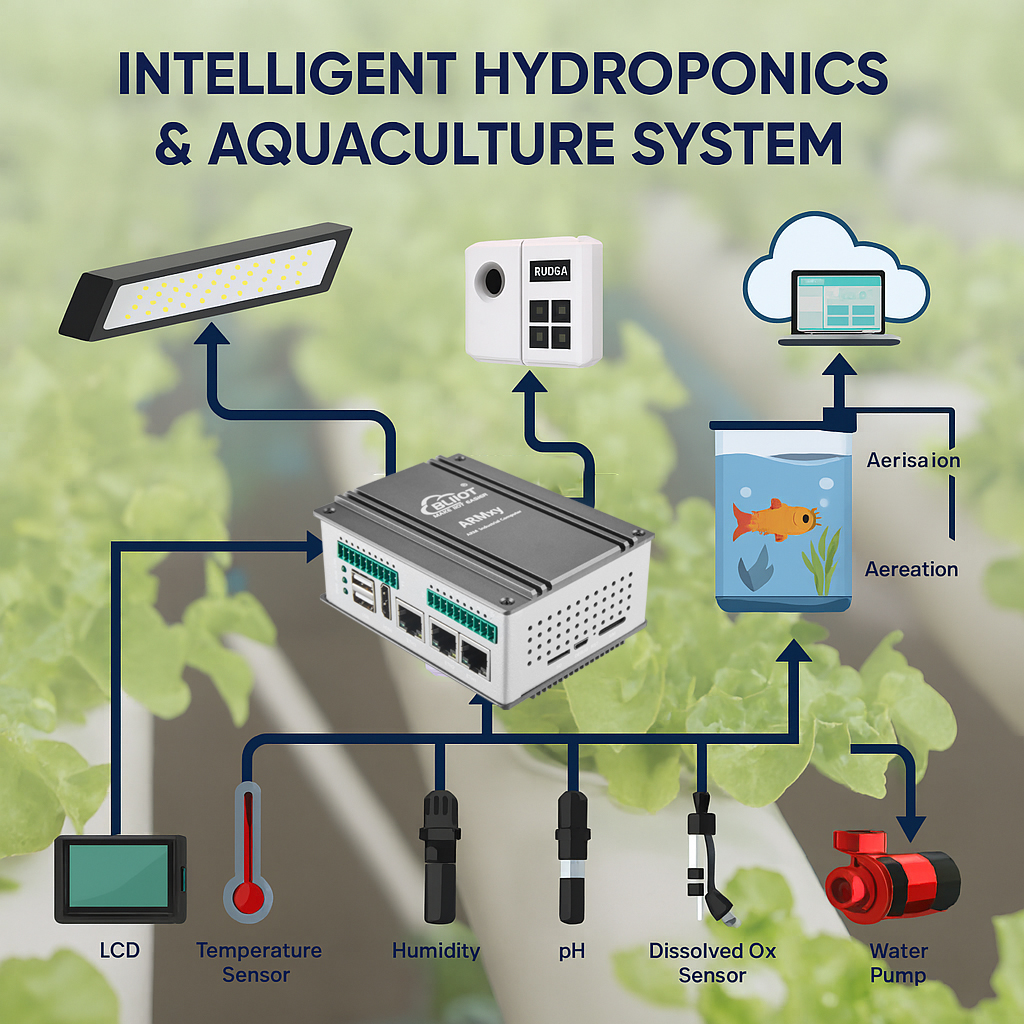
A typical ARM-based smart Hydroponics system consists of four main layers:
-
Data Acquisition Layer
-
Includes pH sensors, DO probes, temperature sensors, EC probes, and water level sensors.
-
The ARM controller collects real-time data through ADC or serial interfaces.
-
Intelligent Control Layer (Core)
-
ARM controllers (e.g., BL410 based on RK3568 or BL440 based on RK3576) run on Linux and support Node-RED or Python control logic.
-
Real-time control decisions:
-
Low DO → Start aeration pump
-
Low water level → Trigger water refill
-
Abnormal pH → Activate regulation system
-
Enables edge AI analysis for anomaly detection and predictive control.
-
Communication & Cloud Layer
-
Uses MQTT, HTTP, or Modbus TCP protocols for cloud connectivity.
-
Cloud services handle data storage, visualization, alerts, and remote configuration.
-
Monitoring & Operation Layer
Key Features
✅ Fully Automated Control – Manages aeration, lighting, and water circulation intelligently.
✅ AI-Based Predictive Maintenance – Edge AI forecasts potential water quality deterioration.
✅ Cloud Visualization – Real-time dashboards for performance and analytics.
✅ Offline Reliability – Local logic continues to run even when the network is down.
✅ Energy Efficiency – Smart scheduling reduces energy usage while improving yield.
Application Example
In a smart agriculture demonstration project, a BL410 ARM controller was used to build a smart hydroponics system that achieved:
-
Water quality accuracy within ±0.1 units,
-
A 12% increase in fish survival rate,
-
18% reduction in energy consumption,
-
24-hour unmanned operation with remote monitoring and automatic alarms.
Conclusion
The integration of ARM controllers transforms hydroponics from passive monitoring to active intelligent control.
With strong computational performance, low power consumption, and edge AI capability, ARM controllers are becoming the central brain of smart agriculture and circular ecosystems.
In the future, as AI hydroponics and IoT technologies continue to evolve, ARM-based hydroponics systems will lead the way in delivering more efficient, eco-friendly, and intelligent agricultural solutions.


