The emergence of AI edge controllers signals a fundamental shift in industrial O&M from "reactive" to "predictive" and "self-optimizing" paradigms. It not only makes equipment "smarter" but also breathes "life" into production systems.
Case Details
In the wave of digital transformation in manufacturing, a profound shift is underway in equipment operation and maintenance (O&M) practices. Traditional production lines relied on manual inspections and post-failure repairs, but AI edge controllers are now propelling enterprises from "reactive maintenance" to "proactive management," enabling intelligent and self-healing production systems that infuse industrial sites with renewed vitality.
The Pain Points of Traditional Reactive Maintenance
In conventional factories, equipment maintenance often follows a "fix after failure" approach. This reactive O&M model reveals three core issues:
- High Downtime Costs: Equipment failures halt production lines, severely impacting delivery schedules and order fulfillment;
- Elevated Maintenance Expenses: Emergency repairs frequently lead to spare parts waste and overtime labor, amplifying operational burdens;
- Low Data Utilization: Vast amounts of runtime data go untapped, hindering informed decision-making.
This paradigm not only inflates enterprise costs but also constrains production efficiency and equipment reliability, demanding urgent innovation.
AI Edge Controllers: Empowering Equipment with an "Intelligent Brain"
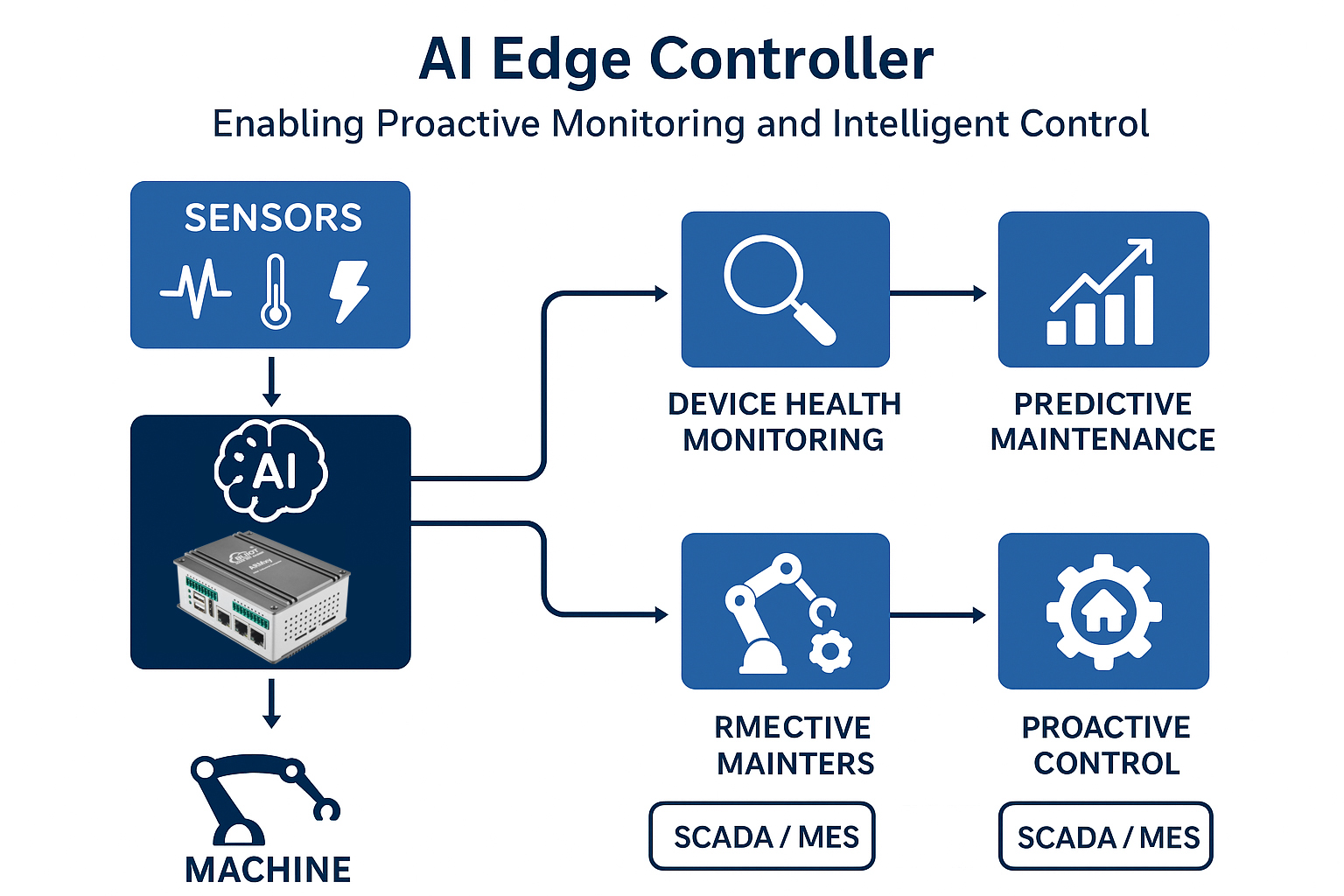
An AI edge controller is an intelligent terminal that integrates data acquisition, AI computing, and automated control. Deployed directly on the production floor, it leverages low-power, high-performance ARM architecture chips for localized AI analysis and decision-making, independent of cloud servers.
The controller captures key parameters such as vibration, temperature, current, energy consumption, and air pressure in real time, using built-in AI models to assess equipment status. For instance, the BL440 AI edge controller, based on the RK3568 architecture, features a 6TOPS NPU for precise detection of motor bearing wear trends and pump station abnormal vibrations, issuing millisecond-level alerts to avert downtime risks.
As a result, equipment evolves from "silent performers" to "smart nodes" capable of self-perception and instant response.
From Post-Failure Repairs to Predictive Maintenance
The greatest value of AI edge controllers lies in enabling predictive maintenance (Predictive Maintenance). By fusing historical and real-time data, it identifies potential risks in advance and generates maintenance schedules.
Typical applications include:
- Abnormal bearing vibration spectra trigger automatic wear assessment and preemptive replacement alerts;
- Current fluctuations exceeding thresholds prompt AI-predicted motor overheating risks, with immediate parameter adjustments;
- Energy consumption analysis revealing efficiency drops leads to autonomous optimization of control strategies.
Real-world deployments show that enterprises adopting AI edge control systems achieve an average 30% reduction in equipment failure rates and nearly 50% improvement in maintenance efficiency.
Proactive Management: From Isolated Intelligence to System Synergy
Beyond standalone decisions, AI edge controllers integrate seamlessly with upper-level systems (e.g., SCADA, MES) via protocols like Ethernet, CAN, RS485, OPC UA, and MQTT, facilitating holistic optimization.
For example, if a device exhibits abnormal energy consumption, the controller coordinates speed adjustments with adjacent segments to maintain overall production rhythm. Through edge synergy, the entire factory forms a closed-loop ecosystem of "real-time monitoring—intelligent decision-making—adaptive control," extending from single-device smarts to line-wide proactive management.
Represented by Beilai Tech's ARM AI edge controller BL440 series demonstrates exceptional practicality and reliability in industrial settings:
- Core Hardware: Powered by Rockchip RK3576 quad-core processor with integrated 6TOPS AI NPU;
- Communication Support: Compatible with EtherCAT, CAN, RS485, and other multi-protocols;
- Software Ecosystem: Built-in AI model deployment .
- Energy Efficiency: Supports 24/7 continuous operation with power consumption under 5W.
In areas like equipment health management, energy optimization, and production line pacing, the BL440 has enabled multiple manufacturing enterprises to transition from "reactive maintenance" to "proactive management."
Toward the Vision of Self-Healing Factories
Looking ahead, AI edge controllers will drive the realization of "self-healing smart factories":
- Equipment autonomously senses status changes;
- AI algorithms dynamically adjust control strategies in real time;
- Systems holistically optimize energy use and capacity allocation.
When production sites gain self-diagnostic and self-regulatory capabilities, true "zero downtime" and "full-lifecycle intelligent O&M" will become attainable realities.
Conclusion
The emergence of AI edge controllers signals a fundamental shift in industrial O&M from "reactive" to "predictive" and "self-optimizing" paradigms. It not only makes equipment "smarter" but also breathes "life" into production systems. In this revolution from "reactive maintenance" to "proactive management," ARM-based AI edge controllers stand as the pivotal engine propelling smart manufacturing to the ground.


