With the rapid advancement of AI and IoT, AIoT as a fusion of the two, is profoundly transforming various aspects of life and industries. AIoT leverages IoT devices to collect vast amounts of data and employs AI for analysis and decision-making, endowing devices with higher levels of intelligence.
With the rapid advancement of Artificial Intelligence (AI) and the Internet of Things (IoT), AIoT (Artificial Intelligence of Things), as a fusion of the two, is profoundly transforming various aspects of life and industries. AIoT leverages IoT devices to collect vast amounts of data and employs AI for analysis and decision-making, endowing devices with higher levels of intelligence. This article explores the primary application scenarios of AIoT and its future development trends.
Major Application Scenarios of AIoT
1. Smart Homes: Creating a Convenient Lifestyle
Smart homes are one of the most accessible applications of AIoT in daily life. Through IoT devices such as smart speakers, sensors, and cameras, users can control appliances via voice commands and remotely monitor home security. For instance, smart thermostats automatically adjust indoor temperatures based on user habits, while smart meters optimize household electricity usage to reduce energy consumption. Additionally, AIoT enhances home security by detecting anomalies through smart locks and cameras, sending real-time alerts to users.
2. Smart Cities: Enhancing Urban Efficiency
AIoT plays a critical role in smart city development. Intelligent traffic systems use sensors and AI analytics to optimize traffic light timing, alleviating congestion. Smart parking systems assist drivers in quickly finding available spaces. Environmental monitoring devices collect real-time data on air quality, water quality, and noise levels, informing urban planning. Moreover, AIoT supports public safety through facial recognition and behavior analysis technologies, enabling rapid responses to potential threats.
3. Industry 4.0: Driving Smart Manufacturing
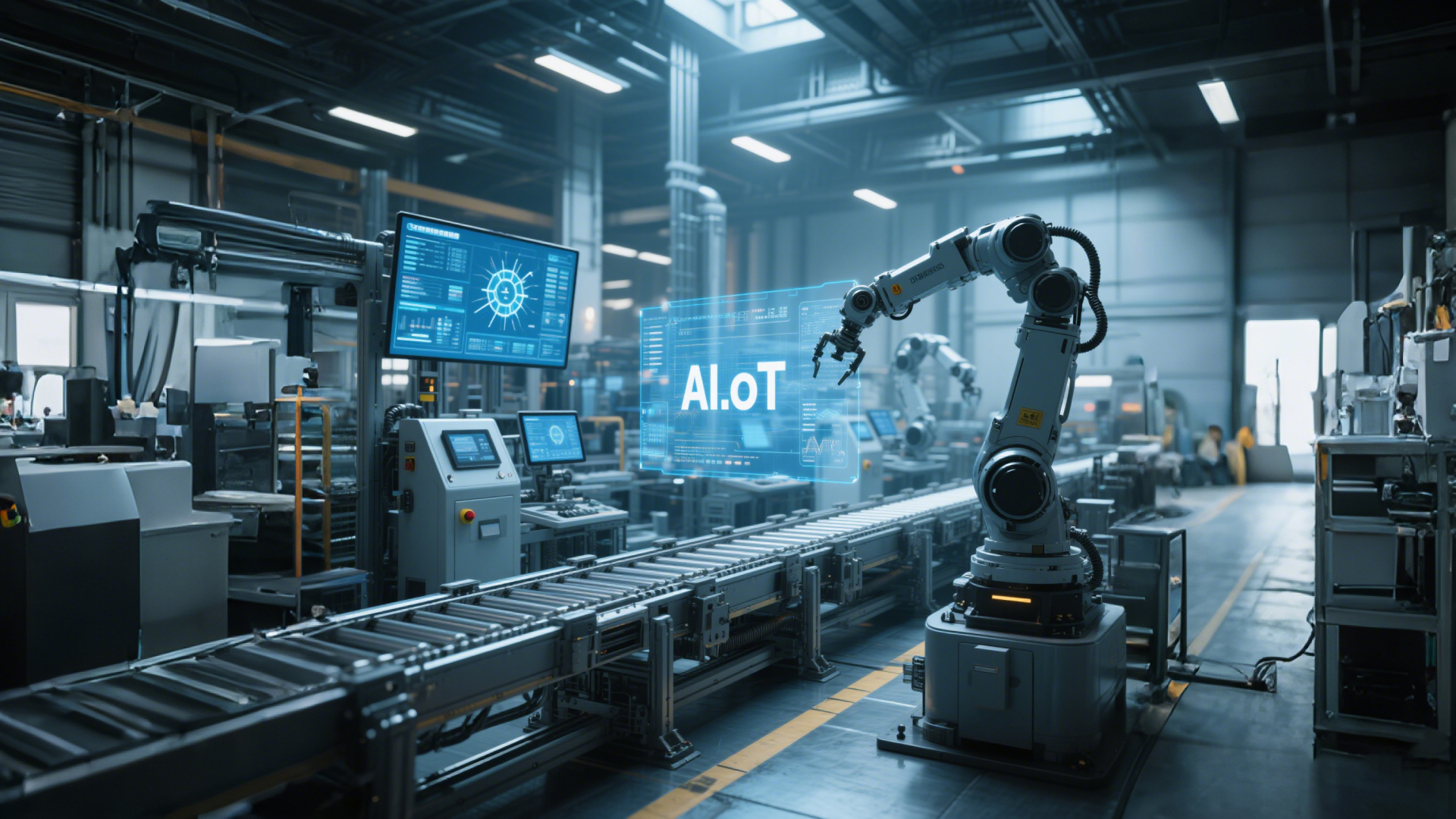
In the industrial sector, AIoT is a cornerstone of Industry 4.0. Sensors monitor equipment conditions in real time, while AI predicts potential failures, minimizing downtime. On production lines, AIoT optimizes processes, improving product quality and efficiency. In supply chain management, IoT devices track goods' locations, and AI forecasts demand, optimizing inventory management.
4. Healthcare: Empowering Precision Medicine
AIoT is revolutionizing healthcare. Wearable devices, such as smartwatches, monitor heart rate, blood pressure, and other metrics in real time, with AI analyzing the data to provide health recommendations. In hospitals, AIoT optimizes equipment scheduling and ward management, enhancing resource utilization. Telemedicine uses IoT devices to transmit patient data, combined with AI-assisted diagnostics, delivering high-quality healthcare to remote areas.
5. Precision Agriculture: Boosting Farming Efficiency
AIoT brings precision to agriculture. Soil sensors monitor moisture and nutrient levels, and AI optimizes irrigation and fertilization strategies. Drones equipped with cameras and AI detect crop pests and diseases in real time, reducing pesticide use. In livestock management, smart devices monitor animal health and location, improving breeding efficiency.
6. Retail and Logistics: Streamlining Business Operations
In retail, AIoT enables automated inventory management through smart shelves and sensors, while AI analyzes consumer behavior to offer personalized recommendations. In logistics, IoT devices track vehicles and goods, and AI optimizes delivery routes, cutting costs. In cold-chain logistics, sensors ensure goods remain at required temperatures, with AI predicting transportation risks.
7. Energy Management: Promoting Sustainability
AIoT drives the development of smart grids by monitoring electricity demand and supply in real time, optimizing the integration of renewable energy. Building energy monitoring systems use sensors to collect data, and AI proposes energy-saving solutions, helping businesses and households reduce energy costs.
Future Trends of AIoT
1. The Role of 5G and Edge Computing
The high-speed, low-latency capabilities of 5G networks will significantly enhance AIoT devices' connectivity and data transfer efficiency. Edge computing processes data locally, reducing reliance on the cloud and improving real-time performance and security. Together, they will advance AIoT applications in autonomous driving, industrial automation, and more.
2. Data Security and Privacy Protection
As the number of AIoT devices surges, data security and privacy concerns become increasingly prominent. In the future, AIoT systems will adopt encryption technologies and decentralized architectures to safeguard user data. Simultaneously, improved regulations will ensure the healthy development of AIoT.
3. Cross-Industry Integration and Ecosystem Building
The future of AIoT lies in deep cross-industry integration. For example, smart city systems for transportation, energy, and healthcare will interconnect via AIoT, forming efficient ecosystems. Collaboration among enterprises will also drive the creation of standardized protocols, enhancing device compatibility.
4. Advancements in Intelligence Levels
With progress in AI algorithms, AIoT devices will gain stronger autonomous learning and decision-making capabilities. For instance, smart home systems could predict user needs based on long-term behavior and adjust settings automatically, while industrial equipment could optimize complex production processes through reinforcement learning.
Advantages of ARM Industrial PCs Paired with NPUs in AIoT Applications
The combination of ARMxy series ARM industrial PC BL410 and 1 Tops Neural Processing Units (NPUs) offers significant advantages in AIoT applications. Firstly, the ARM architecture, known for its high energy efficiency and low power consumption, is particularly suitable for resource-constrained IoT devices, enabling stable, long-term operation at the edge. NPUs, as hardware accelerators optimized for AI computations, significantly enhance devices' ability to process complex AI models, such as image recognition, speech processing, and real-time data analysis. Together, they enable efficient localized AI inference at the edge, reducing dependence on the cloud, lowering latency, and minimizing bandwidth costs. Additionally, the compact size and high integration of ARMxy series ARM industrial PC BL410 facilitate deployment in industrial, agricultural, and healthcare settings, while NPUs' high-performance computing ensures real-time processing and accuracy. For example, in smart manufacturing, ARM industrial PCs paired with NPUs can rapidly analyze sensor data to predict equipment failures; in smart cities, they can process traffic camera data in real time to optimize traffic flow. This combination not only enhances AIoT system performance but also reduces energy consumption and operational costs, providing reliable support for large-scale deployments.
In addition, ARMxy such as the BL370 series, BL440 series, and BL450 series also support AI computing power and can be applied to different solutions according to needs.
Conclusion
AIoT, as a convergence of artificial intelligence and the Internet of Things, is reshaping lifestyles and industrial landscapes. From smart homes to smart cities, from precision agriculture to Industry 4.0, AIoT's applications are vast and full of potential. The integration of ARMxy Series industrial PCs with NPUs further strengthens AIoT's capabilities in edge computing, offering efficient, cost-effective solutions across industries. Looking ahead, with ongoing technological advancements and ecosystem improvements, AIoT will unlock greater value in more domains, driving convenience and sustainability for society. However, technological progress must also address security and privacy concerns to ensure AIoT remains a reliable force for human advancement.


