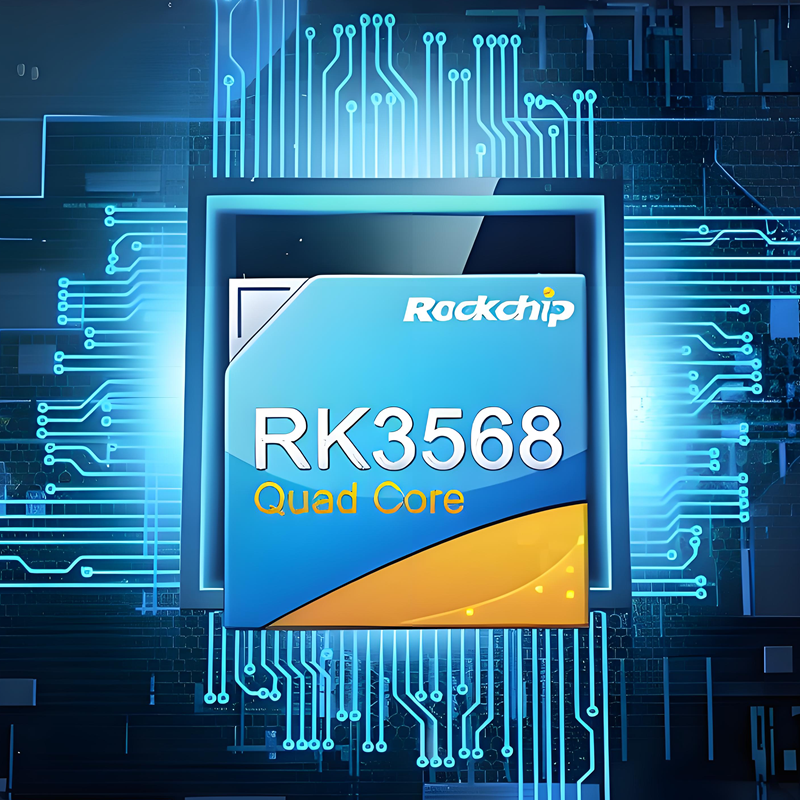
RK3568 and RK3562 are ARM-based processors launched by Rockchip, targeting industrial, IoT, and edge computing applications. Although both belong to the RK35 series, they differ in performance, features, and application scenarios.
Differences Between Rockchip RK3568 and RK3562
RK3568 and RK3562 are ARM-based processors launched by Rockchip, targeting industrial, IoT, and edge computing applications. Although both belong to the RK35 series, they differ in performance, features, and application scenarios. Below are the main differences between the two:
1. Core Architecture and Performance
-
RK3568:
-
Features a quad-core ARM Cortex-A55 architecture with a maximum clock speed of 2.0 GHz.
-
Integrates a dual-core ARM Mali-G52 GPU, supporting OpenGL ES 1.1/2.0/3.2 and Vulkan 1.1.
-
Equipped with a 0.8 TOPS NPU (Neural Processing Unit) for AI inference and deep learning tasks.
-
Offers higher performance, making it suitable for scenarios requiring greater computing power.
-
RK3562:
-
Features a quad-core ARM Cortex-A53 architecture with a maximum clock speed of 1.8 GHz/2.0 GHz.
-
Integrates a single-core ARM Cortex-M0 co-processor, ideal for real-time control and low-power tasks.
-
Equipped with a 1 TOPS NPU, providing slightly higher AI performance than the RK3568.
-
Offers slightly lower performance but better power efficiency, making it suitable for medium-computing applications.
2. Multimedia and Display Support
-
RK3568:
-
Supports 4K@60fps H.265/H.264 video decoding and 1080P@60fps H.264 video encoding.
-
Supports dual-screen display with up to 4K output.
-
Stronger multimedia performance, ideal for video processing and machine vision applications.
-
RK3562:
-
Supports 4K@30fps H.265/H.264 video decoding and 1080P@60fps H.264 video encoding.
-
Supports single-screen display with up to 1080P output.
-
Slightly weaker multimedia performance but still sufficient for most industrial applications.
3. Interfaces and Expandability
-
RK3568:
-
Offers richer interfaces, including PCIe 3.0, SATA 3.0, and USB 3.0.
-
Supports dual Gigabit Ethernet, making it suitable for network-intensive applications.
-
Greater expandability, ideal for complex system designs.
-
RK3562:
-
Features relatively simpler interfaces, including USB 2.0 and 10/100M Ethernet.
-
Moderate expandability, suitable for small to medium-sized embedded systems.
4. Power Consumption and Thermal Management
-
RK3568:
-
Higher power consumption, requiring better thermal design.
-
Suitable for high-performance applications with adequate cooling solutions.
-
RK3562:
-
Lower power consumption, with less stringent thermal requirements.
-
Suitable for power-sensitive and space-constrained applications.
5. Application Scenarios
-
RK3568:
-
Ideal for high-performance applications such as industrial control, edge computing, machine vision, smart NVRs, and video conferencing terminals.
-
Excels in scenarios requiring strong multimedia processing and AI capabilities.
-
RK3562:
-
Ideal for medium-performance applications such as industrial IoT gateways, energy storage systems, AGV robots, and smart home devices.
-
Offers better cost-effectiveness for low-power, real-time control, and AI inference scenarios.
6. Price and Cost-Effectiveness
Summary Comparison Table:
| Feature |
RK3568 |
RK3562 |
| CPU Architecture |
Quad-core Cortex-A55 (up to 2.0 GHz) |
Quad-core Cortex-A53 + Cortex-M0 |
| GPU |
Dual-core Mali-G52 |
No dedicated GPU |
| NPU Performance |
0.8 TOPS |
1 TOPS |
| Video Decoding |
4K@60fps H.265/H.264 |
4K@30fps H.265/H.264 |
| Video Encoding |
1080P@60fps H.264 |
1080P@60fps H.264 |
| Display Support |
Dual-screen, up to 4K output |
Single-screen, up to 1080P output |
| Interface Richness |
Richer (PCIe 3.0, SATA 3.0, etc.) |
Simpler (USB 2.0, 10/100M Ethernet) |
| Power Consumption |
Higher |
Lower |
| Typical Applications |
High-performance industrial control, edge computing, machine vision |
Industrial IoT, energy storage systems, AGV robots |
Selection Recommendations:
-
Choose RK3568 if you need higher performance, stronger multimedia capabilities, and richer expandability.
-
Choose RK3562 if you prioritize cost-effectiveness, low power consumption, and real-time control capabilities.
I hope this comparison helps you choose the right processor for your needs! If you have further questions, feel free to ask.