A System-on-Module (SoM) is a compact embedded circuit board that integrates core computing components to accelerate product development and deployment. It sits between a traditional System-on-Chip (SoC) and a full motherboard, offering high flexibility and scalability. SoMs are widely used in industrial automation, robotics, surveillance, edge computing, and more.
Key Features of SoM
-
Modular Design: Combines CPU, GPU, RAM, storage, and wireless communication (e.g., Wi-Fi, Bluetooth) on a standardized PCB.
-
Rapid Deployment: Developers can plug the SoM into a custom carrier board to build a complete system, avoiding complex low-level hardware design.
-
High Expandability: Supports various I/O interfaces (GPIO, USB, Ethernet, SPI, UART), making it easy to connect sensors, displays, and peripherals.
-
OS Compatibility: Compatible with Linux, Android, RTOS, and often comes with pre-installed drivers and SDKs to speed up software development.
SoM vs. SoC Comparison
| Feature |
SoM (System-on-Module) |
SoC (System-on-Chip) |
| Composition |
Multiple chips on a PCB |
All functions integrated into a single chip |
| Expandability |
High, supports external peripherals |
Limited by chip packaging |
| Development Time |
Short, ideal for rapid prototyping |
Long, requires custom design and validation |
| Use Cases |
Industrial control, edge computing, smart terminals |
Smartphones, smartwatches, consumer electronics |
Typical Applications
-
Industrial Gateways & Controllers: ARM-based edge gateways supporting multi-protocol communication and remote management.
-
Smart Vision Systems: Integrated AI accelerators for image recognition and video analytics.
-
Robotics & Automation: Real-time control and high-performance computing.
-
Medical Devices: Data acquisition, processing, and remote diagnostics.
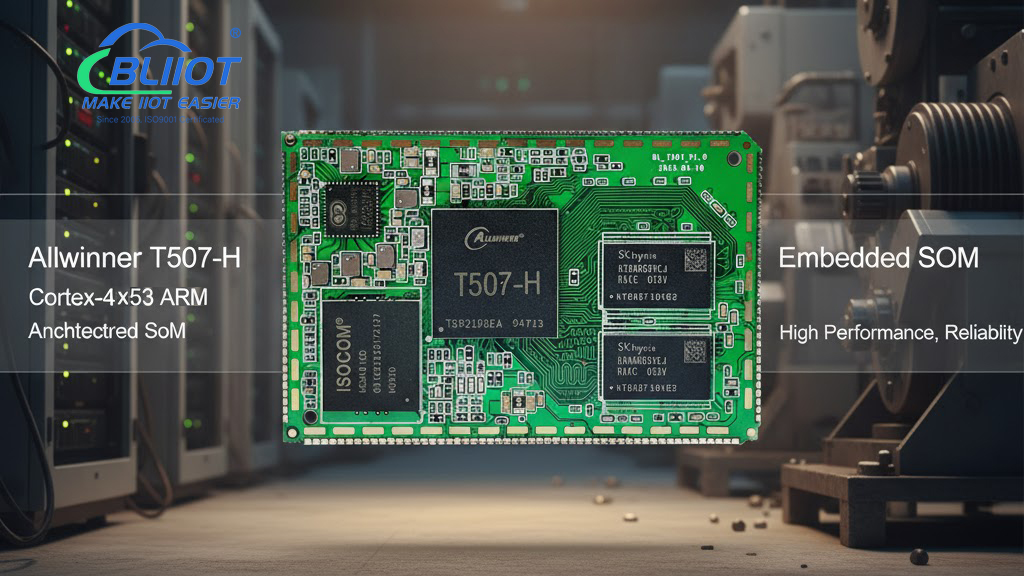
The
SOM340 series core board is built on the high-performance domestic processor Allwinner T507-H, featuring a quad-core ARM Cortex-A53 architecture with a clock speed up to 1.416GHz. With its rich interface resources—including UART, SPI, PWM, ADC, CAN, and EMAC—and robust industrial-grade design, SOM340 is highly suitable for control-oriented devices such as motion controllers, data acquisition units, power DTUs, and automation terminals. Whether in time-critical industrial environments or multi-protocol edge gateways, SOM340 delivers a reliable and efficient embedded solution.


